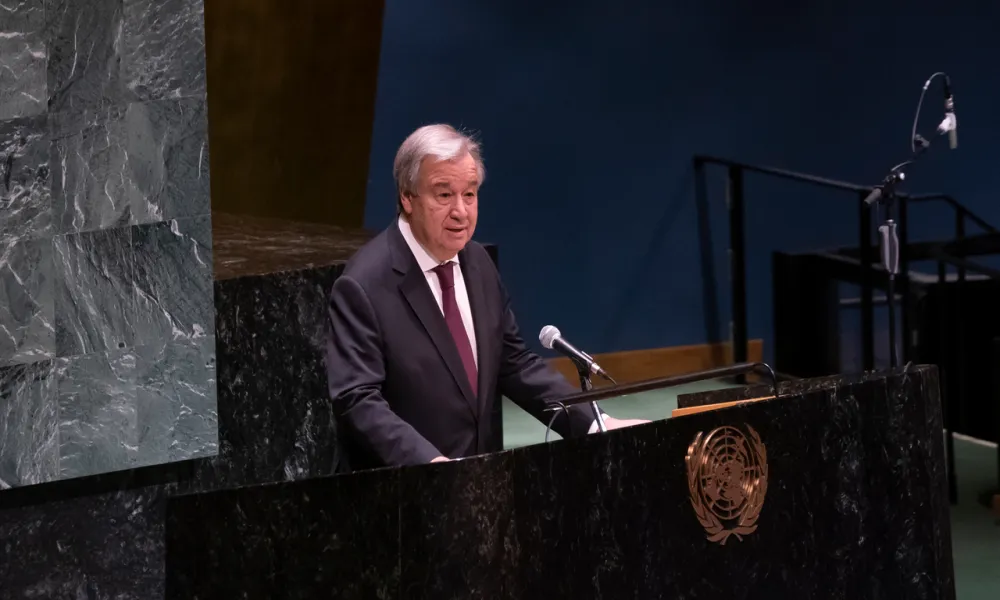
UN Secretary-General Antonio Guterres has described the current global climate as a “moment of crisis” and a “moment of choice”, urging states to recommit to international law and the authority of global institutions.
Speaking in The Hague at an event marking the 80th anniversary of the International Court of Justice, Guterres said such periods “reveal who we are and what we stand for”.
Law over power
He stressed that the court’s rulings, including provisional measures, are binding on all parties to a case. “Respect for these decisions is not optional — it is an obligation under the Charter,” he said.
Recalling the aftermath of World War II, Guterres said global leaders had chosen to reject a future governed by coercion and violence, instead building an international system rooted in the United Nations Charter and the rule of law.
“The power of law must always prevail over the law of power,” he said.
Highlighting the court’s historic role, Guterres noted that its judgments and advisory opinions have helped shape the modern world, adding that demand for its work is now higher than ever — a sign of trust in its authority and independence.
Violations of international law in plain view
He also pointed to increased female representation among the court’s judges as a sign of progress, alongside modernised working methods that have strengthened its effectiveness and resilience.
However, Guterres warned that violations of international law are unfolding “before our eyes”, with military operations breaching fundamental rules of conflict, humanitarian obligations being ignored, and protections afforded to the UN itself being undermined.
He said institutions designed to uphold justice are facing growing pressure and challenges, with this erosion occurring “not at the margins, but at the core” of the international system — including among states with particular responsibility for maintaining global peace and security.
“When the law of force replaces the force of law, instability becomes contagious,” he warned, adding that conflicts spread across borders, economic shocks reverberate globally, and the most vulnerable suffer first and most.
The right choice
In closing, Guterres called on states to choose a future governed by the rule of law rather than raw power, stressing that international law provides a shared framework for the peaceful resolution of disputes.
“Weakening it erodes the foundations of global stability, while strengthening it is an investment in a world governed by justice, not fear,” he said, urging renewed commitment to respecting court rulings and implementing its opinions.
“At this moment of crisis, this is the only right choice,” he concluded.