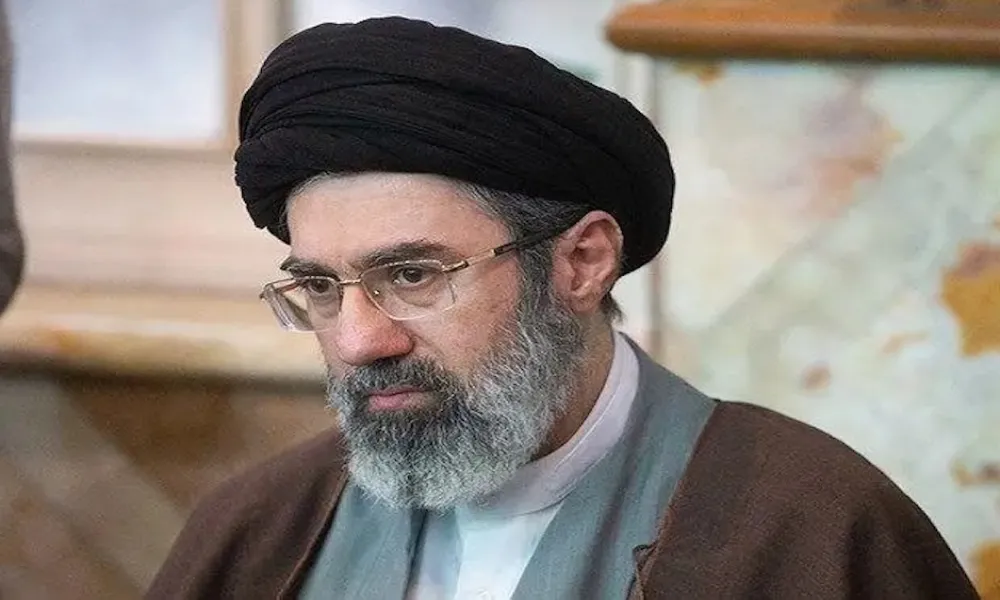
Long known as the Islamic Republic’s most influential invisible figure, the 56 year old cleric now steps from the shadows into the most powerful office in the country. His appointment signals continuity and defiance rather than immediate change, reinforcing the cohesion of Iran’s clerical and security establishment at a moment of war and external pressure. Whether Mojtaba Khamenei proves to be a hardline guardian of the revolutionary system or a pragmatic leader capable of strategic compromise remains one of the central questions shaping the future of Iran and the wider Middle East.
Few figures in the Islamic Republic of Iran have been spoken about so often and seen so rarely as Mojtaba Khamenei. For decades, the second son of Iran’s late Supreme Leader Ali Khamenei operated almost entirely outside the public eye. He held no official post, granted no interviews, and rarely appeared in state media. Yet within the opaque architecture of the Islamic Republic, his name circulated persistently in whispers of influence and proximity to power.
That long period of political invisibility has now ended. Mojtaba Khamenei has been formally chosen as the Supreme Leader of Iran following the death of his father in the Israeli and United States strike of February 28. His appointment marks the most consequential leadership transition in the Islamic Republic since the death of Ayatollah Ruhollah Khomeini in 1989.
The question confronting Iran and the wider region is not only who Mojtaba Khamenei is, but what his leadership means for a country already at war and for a Middle East on edge.
An appointment that signals defiance
Judging from the circumstances surrounding his elevation, Mojtaba Khamenei’s appointment does not suggest an imminent moderation of Iranian policy or a quick end to the war.
Instead, the decision appears to represent a message of continuity and defiance from Iran’s ruling establishment. By elevating a figure so closely associated with the inner circle of the previous Supreme Leader, the clerical and security elite signaled that the system intends to preserve cohesion and stability rather than embark on a dramatic political shift.
Critics outside Iran quickly framed the appointment as evidence of dynastic succession. Yet within the Iranian political narrative the decision has been presented very differently.
For supporters of the Islamic Republic, Mojtaba Khamenei’s rise is not portrayed as hereditary succession but as the continuation of a revolutionary lineage forged through sacrifice and confrontation with foreign adversaries.
The symbolism surrounding his appointment is particularly powerful within Shiite political culture.
Martyrdom and religious symbolism
The killing of Ali Khamenei in the February 28 attack immediately transformed the succession debate into a narrative shaped by the language of martyrdom.
In Shiite historical memory, martyrdom occupies a central place. The most powerful symbol is Hussein, the son of Ali and grandson of the Prophet Mohammed, who was killed in the Battle of Karbala in 680 CE. His death is commemorated every year as an act of resistance against injustice and tyranny.
Within this symbolic framework, the death of Iran’s Supreme Leader at the hands of foreign enemies carries profound religious and political resonance. Mojtaba Khamenei now stands not simply as the son of a former leader but as the son of a martyr in a conflict framed by Iranian authorities as a struggle for national and religious survival.
That narrative alone has strengthened his position among conservative circles in Iran.
Ironically, statements made by United States President Donald Trump during the crisis may also have reinforced Mojtaba Khamenei’s standing. Trump had publicly insisted that Washington would have a say in the selection of Iran’s next Supreme Leader and warned that Mojtaba would be “unacceptable.”
Such remarks were widely interpreted inside Iran as an attempt at external interference in the country’s internal political process. In practice, they may have strengthened the perception among Iran’s ruling elites that choosing Mojtaba Khamenei was an act of resistance to outside pressure.
The gatekeeper of power
For years Mojtaba Khamenei exercised influence from within the institution known as Beyt-e Rahbari, the office of the Supreme Leader.
This powerful administrative structure manages relations between the Supreme Leader and Iran’s political factions, clerical networks, and security institutions. Although Mojtaba held no official title within the government, analysts long described him as one of the most influential intermediaries operating inside that system.
Many observers believe he cultivated particularly strong relationships with the Islamic Revolutionary Guard Corps. The Revolutionary Guards have evolved into one of the most powerful pillars of the Islamic Republic, combining military authority with significant economic and political influence.
In such a system, influence often flows not through formal bureaucratic titles but through networks of trust and access.
Mojtaba Khamenei functioned as precisely such a political broker.
That experience may allow him to consolidate power relatively quickly now that he occupies the office himself.
The shadow of the protests
Yet Mojtaba Khamenei’s record is also controversial.
His name first entered wider political debate during the crisis that followed the disputed presidential election of 2009. The protests that erupted across Iran in response to Mahmoud Ahmadinejad’s re election became known as the Green Movement and represented one of the most serious domestic challenges to the Islamic Republic.
Opposition figures accused Mojtaba Khamenei of playing a role behind the scenes in coordinating the state’s response to the demonstrations. These claims were never officially confirmed. Nevertheless, they contributed to his reputation as a hardliner closely linked to the country’s security establishment.
Many critics also associate him with later crackdowns on anti government protests, including the repression of demonstrations that erupted in recent years.
Such perceptions have shaped the international image of Iran’s new Supreme Leader as a figure aligned with the more conservative and security oriented factions of the state.
A generational shift in Tehran
At fifty six, Mojtaba Khamenei represents a generational change in Iran’s highest leadership. While his political instincts are widely seen as conservative, many observers believe the emerging generation within Iran’s ruling elite is also more pragmatic than the revolutionary figures who shaped the early decades of the Islamic Republic.
The combination of ideological commitment and pragmatic calculation could define his leadership. For the moment, however, expectations of immediate policy change appear limited.
Iranian officials and analysts expect Mojtaba Khamenei’s first statements to emphasize themes of resistance, unity, resilience, and continuity. These themes have long been central to the Islamic Republic’s political vocabulary.
Hardliners and the paradox of compromise
Yet the history of the Middle East contains a recurring paradox. Hardline leaders often prove the most capable of making strategic compromises.
It was Ayatollah Ruhollah Khomeini himself who in 1988 accepted a ceasefire that ended the devastating Iran Iraq war, describing the decision as “drinking a chalice of poison.” Similarly, Israeli Prime Minister Menachem Begin signed the peace agreement with Egypt, while Yitzhak Rabin and Palestine Liberation Organisation Chairman Yasser Arafat accepted the principle of a two state solution.
Some Iranian political figures believe Mojtaba Khamenei may eventually prove capable of a similar pragmatic turn. Abdolreza Davari, a politician close to the Iranian leadership, suggested that a figure with strong support from conservative institutions may actually possess greater freedom to explore de escalation with the United States.
“If there is anyone who could move toward some sort of de escalation with the United States, it is him,” Davari said. “Any other person would face backlash from the ruling class and conservatives.”
Whether such a scenario emerges will depend on many factors, including the trajectory of the war itself.
A leader with a target on his back
For the moment, however, Mojtaba Khamenei begins his leadership under extraordinary pressure.
Israel has publicly vowed to eliminate whoever succeeds Ali Khamenei. The new Supreme Leader therefore assumes office as a man with a target on his back.
His survival will become one of the most immediate tests of the ability of Iranian security institutions to protect the country’s highest leadership. It will also serve as an indicator of how deeply Israeli and United States intelligence services have penetrated the Iranian state.
The stakes could hardly be higher.
Iran’s new Supreme Leader enters office at a moment when the Islamic Republic faces war, economic strain, and growing regional confrontation.
For years Mojtaba Khamenei was known as the most powerful invisible figure in Iran. Now he stands at the center of the system he once influenced from the shadows. And the direction he chooses could shape not only the future of Iran but the trajectory of the entire Middle East.