Owing to its geographical position, Cyprus once again finds itself at the centre of developments in the region, this time amid the rapid deterioration of relations between the United States and Iran and the risk of potential American strikes.
The concentration of significant US naval and air forces in the wider area, alongside reports that in the event of an attack on Iran American vessels could deploy in the sea corridor between Cyprus and Israel to benefit from a dual protective umbrella — from Israel and the British Bases — has prompted renewed public concern.
Speaking to local media, Defence Minister Vasilis Palmas acknowledged that the prevailing geopolitical fluidity understandably generates a sense of insecurity among the public. However, he stressed that there is no reason for alarm.
Mr Palmas noted that Cyprus enjoys the respect of countries across the region, both allied states and others that may support different powers, and has succeeded in maintaining balanced relations. He further confirmed that despite heightened military activity over the past month, “no one has requested permission to use the facilities of the Republic of Cyprus”.
He reiterated, however, that given the situation, should a request of a humanitarian nature be submitted, “we will of course examine it, as this is our role”. Cyprus, he added, is a democratic and peaceful state that does not engage in armed conflicts and, within its capabilities, would provide humanitarian assistance if required, as it has done in the past.
Trump weighs “limited strike”
US President Donald Trump has said he is considering the possibility of a limited strike against Iran, even as negotiations over a draft nuclear agreement continue, with both sides seeking swift sanctions relief while simultaneously exchanging threats.
He acknowledged that he is weighing a limited military option following orders for a substantial naval deployment to the Middle East, aimed at increasing pressure on Tehran to reach a deal curbing its nuclear programme.
The latest warning came after Iran’s foreign minister stated that a draft agreement with Washington could be ready within days, following talks in Geneva earlier this week. Mr Trump subsequently warned that “bad things” would happen if Tehran failed to conclude an agreement within 10 days — a deadline later extended to 15 days, reportedly to allow US forces heading to the region to reach full operational readiness.
US show Of force in the Mediterranean
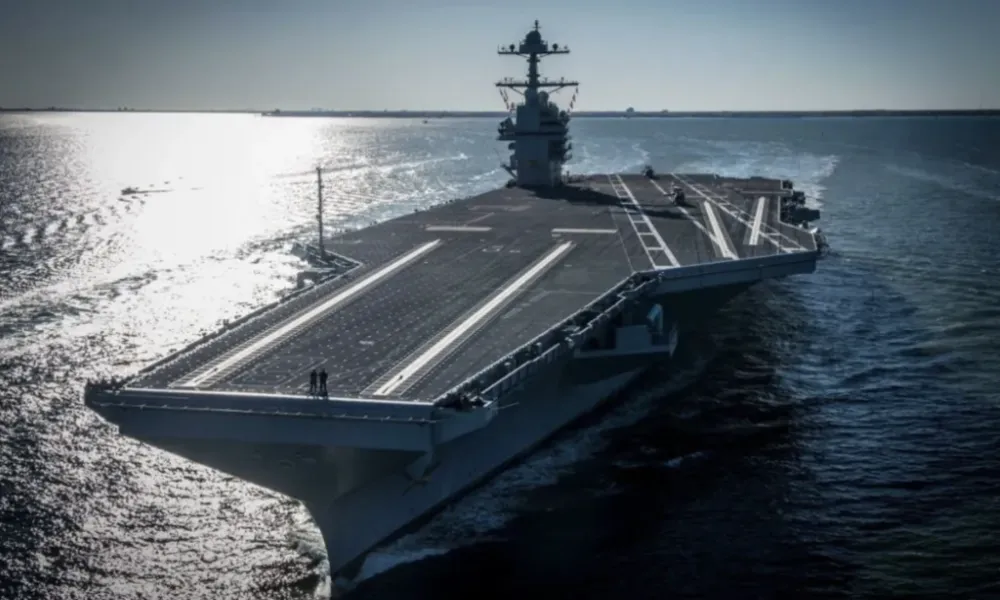
The world’s largest aircraft carrier, the USS Gerald R. Ford, has entered the Mediterranean, according to maritime tracking data, corroborated by the signals emitted by vessels in its strike group.
Tracking websites recorded the Arleigh Burke-class destroyer USS Mahan, an integral part of the carrier strike group, transiting the Strait of Gibraltar.
Military analysts cited in international media suggest several more days will be required before the carrier and its escorts reach the Middle East theatre, where they would be placed on full operational footing and ready to conduct missions should orders for strikes against Iranian forces be issued.
The scenarios
The United States appears poised for possible action against Iran, having reinforced its military presence in the Middle East to levels that analysts say evoke the period preceding the 2003 invasion of Iraq.
While the mobilisation may serve as negotiating leverage, indications of a potential strike are multiplying. According to analysis cited by the BBC, seven broad scenarios could unfold should President Trump give the green light, even initially for limited operations:
-
Surgical strikes and political transition
Targeted attacks on bases of Iran’s Revolutionary Guards, ballistic missile facilities and nuclear infrastructure. -
Regime survival with a moderate shift
The Islamic Republic remains in place but curtails its nuclear and missile programmes and reduces support for regional proxy groups. -
Regime collapse and military rule
Replacement of the current leadership with a hardline military authority centred on the Revolutionary Guards. -
Iranian retaliation against US, Israel and Arab states
Potential strikes on US bases in the Gulf and against Washington’s allies. -
Mining of the Strait of Hormuz
Around a fifth of global liquefied natural gas and up to a quarter of oil supplies transit the Strait of Hormuz. Mining the passage would have immediate repercussions for global trade and energy prices. -
Attack on a US warship
A successful Iranian strike using drones and fast boats against an American vessel — recalling the 2000 al-Qaeda attack on the USS Cole in Yemen — could have grave consequences. -
State collapse and Syria-style chaos
Full destabilisation of Iran, with ethnic and regional tensions fuelling internal conflict. With a population of approximately 93 million, Iran represents a critical geopolitical pillar.
Priority Targets in a joint operation
According to Israel’s Ynet news outlet, in the event of a joint US–Israeli operation, the initial objectives would include:
-
Neutralising Iran’s air defence systems to secure aerial superiority.
-
Destroying ballistic missile stockpiles and drone capabilities.
-
Disabling the naval arm of the Revolutionary Guards to prevent closure of the Strait of Hormuz.
-
Striking underground “missile cities” — extensive storage and launch tunnel networks.
At a secondary level, operations could target strategic and politico-military structures of the regime, weaken its leadership, and potentially focus on senior officials such as Supreme Leader Ali Khamenei.
Analysts caution that the greatest danger lies in the outbreak of a conflict lacking a clear strategic objective or predictable end — a confrontation that could reshape the entire Middle East and reverberate across the global economy.