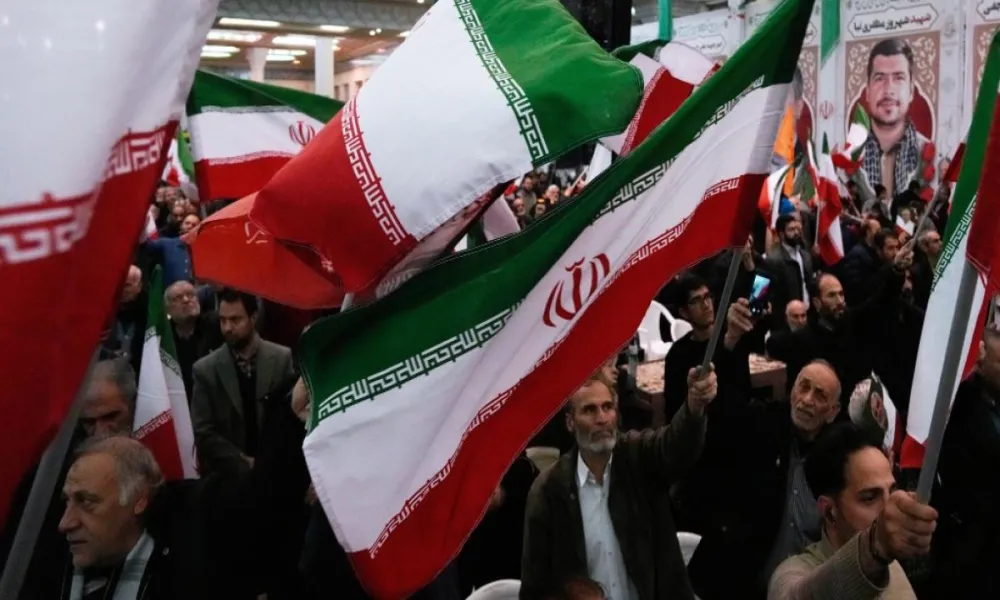
Tehran is projecting defiance toward Washington as US military assets move closer to the region, but beneath the official rhetoric lies a society still shaken by a recent and deadly internal crackdown, whose full scale is only now becoming visible.
In central Tehran, a four-storey government billboard warns the United States: “If you sow the wind, you will reap the whirlwind.” The message, displayed in both English and Persian, depicts a destroyed US aircraft carrier, signalling retaliation should Iran come under attack. The imagery reflects heightened tensions following US President Donald Trump’s statements that an American naval “armada” is being positioned as a contingency.
According to CNN, the USS Abraham Lincoln carrier strike group has moved within striking distance of Iran, reinforcing US military presence amid escalating rhetoric .
A city outwardly calm, inwardly anxious
Reporting from Tehran with official permission, CNN correspondents Frederik Pleitgen and Joseph Ataman describe a capital where daily life appears to have resumed, even as anxiety simmers just below the surface.
Only weeks ago, protests sparked by economic hardship were met with a violent state response, resulting in thousands of deaths, according to multiple human rights organisations. Internet restrictions imposed during the unrest obscured the scale of the crackdown, with new information emerging only recently as connectivity has partially returned .
“I don’t think anything good will come from this,” a Tehran resident told CNN, expressing mistrust toward both the Iranian authorities and the United States. Others dismissed the prospect of an American strike as political brinkmanship rather than imminent action.
Iran signals readiness, dismisses US deployments
Iran’s Revolutionary Guard has adopted a hard line. Its commander warned this week that forces are “finger on the trigger,” while Foreign Ministry spokesperson Esmaeil Baghaei said Tehran was “fully capable” of responding to any attack with consequences that would be “regretful” for the aggressor.
“The arrival of one or several warships does not change Iran’s defensive resolve,” Baghaei said, adding that Iran’s armed forces are closely monitoring US movements.
Iranian officials have also warned that any US strike would trigger retaliation against American allies in the region. Regional diplomats told CNN that several Gulf states have privately urged Washington to avoid military escalation, fearing spillover effects .
Military backdrop shaped by recent Israel conflict
Iranian military officials say missile capabilities have been upgraded following the 12-day conflict with Israel in June, during which Iran launched waves of missiles and drones at Israeli targets. Western defence analysts cited by Reuters assess that while Iran remains conventionally weaker than the US, its regional deterrence capacity has expanded significantly in recent years .
Economic strain deepens public vulnerability
The external pressure comes as Iran’s economy continues to deteriorate. The rial this week fell to around 1.5 million to the US dollar, according to Iranian currency tracking platforms, marking a historic low. Inflation, unemployment and shortages have intensified public frustration, particularly among younger Iranians.
As internet access gradually returns, Iranians are learning the extent of the recent bloodshed for the first time.
“Only now do we understand how many people were killed,” a young man told CNN. “During the blackout, we were living blind.”
Between confrontation and collapse
While Washington signals openness to talks, Iranian officials remain sceptical. A White House official told reporters that the US was willing to engage if Tehran met specific conditions, though no formal diplomatic track has yet emerged.
For many inside Iran, the standoff with the United States is unfolding against the backdrop of fresh internal wounds, unresolved accountability and deepening economic despair, a volatile combination that leaves the country bracing for what comes next.