
The Arctic experienced the warmest year ever recorded, according to a new report by the US National Oceanic and Atmospheric Administration (NOAA), which paints a deeply concerning picture of a region that is particularly vulnerable to the effects of global warming.
Between October 2024 and September 2025, average temperatures in the Arctic were 1.60°C higher than the 1991–2020 baseline, according to the annual Arctic Report Card, which draws on climate data dating back to 1900.
Tom Ballinger, one of the study’s authors from the University of Alaska, told Agence France-Presse that it is “alarming” to witness such rapid warming over such a short period, describing the trend as “unprecedented in recent years and possibly for thousands of years.”
A year of extreme seasonal heat
The period analysed by NOAA included the warmest autumn on record for the Arctic, the second-warmest winter, and the third-warmest summer since records began in 1900.
The Arctic, which surrounds the North Pole, is affected by a phenomenon known as Arctic amplification, whereby the region warms faster than mid-latitudes. This process is driven by several factors, including the loss of snow cover and sea ice.
Record-low sea ice extent
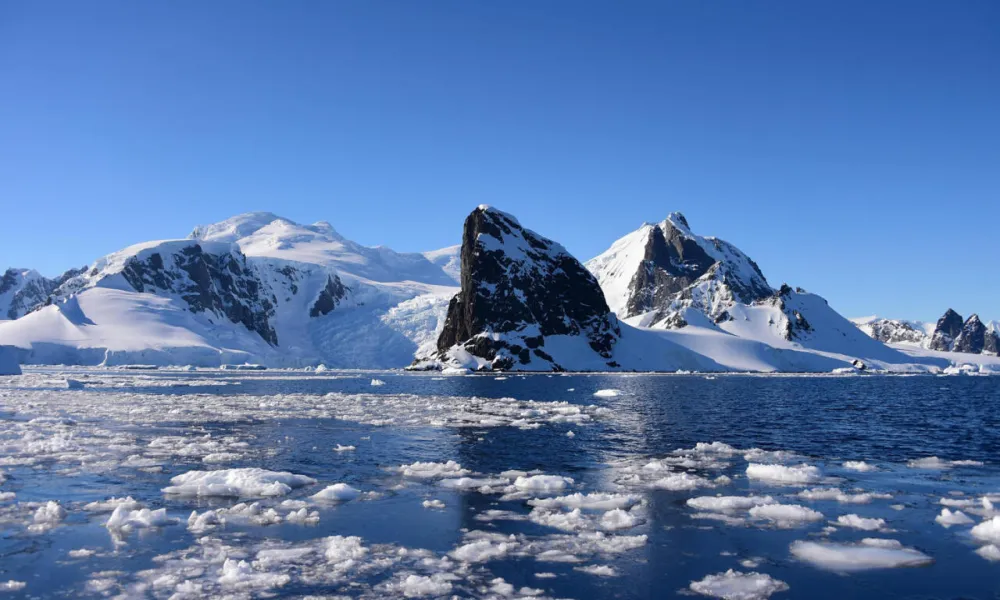
In March 2025, Arctic sea ice retreated to an unprecedented low, recording the smallest maximum extent since satellite monitoring began.
Scientists at the National Snow and Ice Data Center (NSIDC) estimated that Arctic sea ice reached its annual maximum on 22 March, covering approximately 14.33 million square kilometres. This is the smallest maximum extent recorded in more than four decades of satellite observations.
Each winter, sea ice in the Arctic Ocean gradually expands, typically reaching its peak in March. However, due to human-induced global warming, the ice is increasingly struggling to recover.
Threats to Arctic wildlife
This decline poses an “immediate problem for polar bears, seals and walruses, which rely on sea ice as a platform for movement, hunting and breeding,” explained Walter Meier, a co-author of the NSIDC report.
While the melting of sea ice does not directly raise sea levels, unlike the melting of land-based ice sheets and glaciers, it has far-reaching consequences for ecosystems threatened by climate change.
A feedback loop accelerating warming
The loss of sea ice also worsens global warming itself. As the bright, reflective ice surface shrinks, it exposes darker ocean water beneath, which absorbs more solar energy and reflects less back into space.
As the Arctic warms faster than the rest of the planet, temperature differences that help keep cold air trapped near the pole are reduced. According to several studies, this allows cold air outbreaks to spread more frequently to lower latitudes, influencing weather patterns far beyond the Arctic.
Record rainfall in the Arctic
Rainfall levels in the region also reached record highs between October 2024 and September 2025, a period known as the “water year.” This timeframe ranks among the five wettest years since 1950, further underlining the scale and complexity of the climatic changes unfolding in the Arctic.