
Travel sentiment across the EU is reaching historic highs for summer 2026, despite shorter stays, tighter budgets and the crisis in the Middle East, according to the latest report by the European Travel Commission (ETC).
Some 82% of Europeans are planning to travel this spring and summer, marking the highest level recorded since 2020.
Intra-European travel remains dominant, with stronger demand at this stage for destinations in southern Europe and the Mediterranean.
Travellers are becoming more cautious, planning fewer and shorter trips with more moderate budgets.
Spain leads
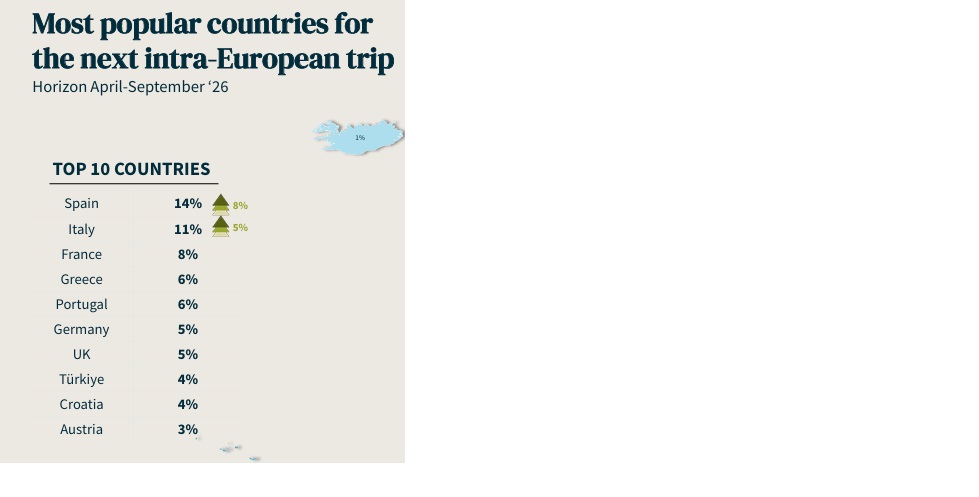
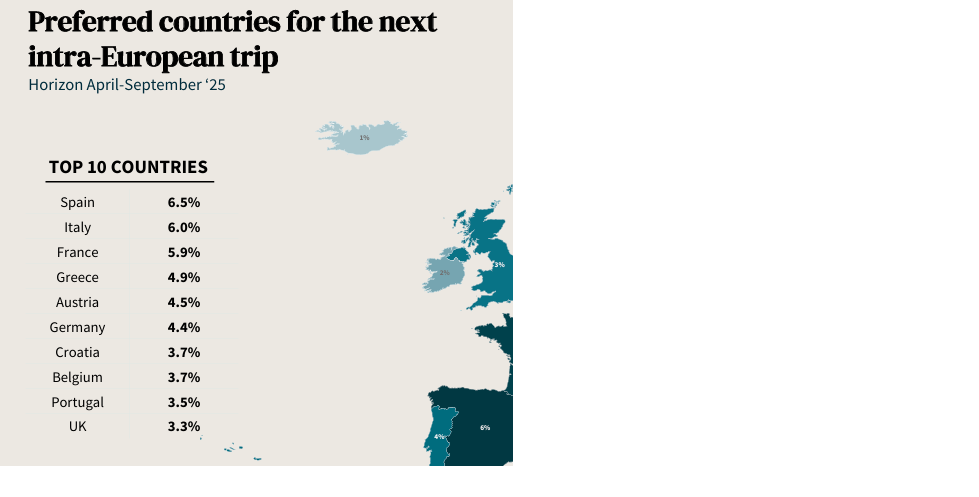
Spain is the top choice for European travellers, with a 14% share, marking a significant increase from 6.5% in the corresponding survey last year.
Italy follows with 11%, also recording a notable rise from 6% a year earlier.
France ranks third with 8%, also gaining momentum from 5.9% last year.
Greece follows with 6%, up from 4.9%, alongside Portugal, also at 6%, compared with 3.5% last year.
The top ten destinations for travel between April and September also include Germany, the United Kingdom, Turkey, Croatia and Austria. It is noted that Turkey was not included among the top ten destinations for Europeans last year.
Travel planning
According to the survey findings, more Europeans plan to reduce their travel this coming spring and summer (39%, +7 percentage points), while demand for two or more trips declines to 57% (–3).
Shorter trips are gaining ground, with 38% planning stays of four to six nights (+3%), while trips of seven to twelve nights decline to 37% (–5%).
Trip duration is shortening overall, and budgets are shifting towards more moderate levels. Spending of up to €1,000 is increasing (+6%), while higher budgets above €1,500 are declining (–9%).
Despite expectations of rising oil prices, travel by car is increasing to 28% (+4%), while reliance on air travel remains stable at 55%.
Safety remains key
The report shows that geopolitical instability is driving a 4% increase in the importance of safety as the main factor in choosing a destination (22%), followed by pleasant and stable weather (15%), while cost-related factors also remain among the main considerations.
Rising travel costs are the primary concern for 20% of respondents (+3%), followed by the potential impact of tensions in the Middle East (18%), marking a significant increase of nine percentage points.
When asked about their response to possible climate disruptions this summer, around two-thirds of Europeans say they would adjust their travel plans, while only 10% to 18% would cancel them altogether.