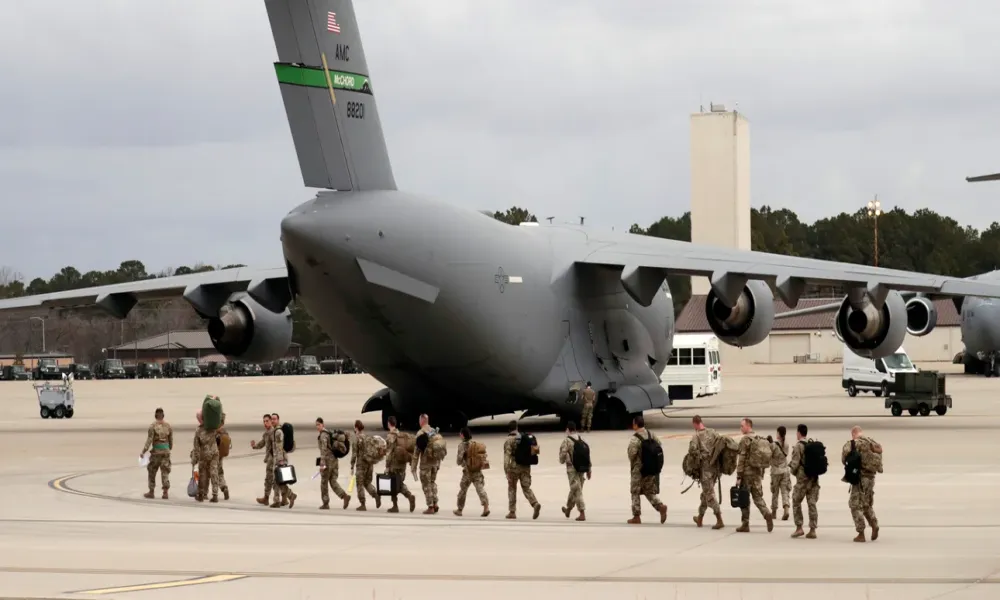
The United States has ordered the withdrawal of around 5,000 troops from Germany over the next six to twelve months, in a move that marks a new phase in transatlantic relations.
The decision, announced by the Pentagon, comes amid heightened geopolitical tensions and an increasingly public rift between Washington and Berlin.
Political backdrop and rising tensions
The move is closely linked to escalating rhetoric between US President Donald Trump and German Chancellor Friedrich Merz. Merz recently criticised US policy on Iran, saying Washington “clearly has no strategy” and was being “humiliated”.
Trump responded sharply, accusing Merz of suggesting that Iran acquiring nuclear weapons would be acceptable. “He doesn’t know what he’s talking about,” Trump said, further intensifying the dispute.
Shortly after, Trump indicated that Washington was reviewing its military footprint in Germany, promising a decision “very soon”. The order was ultimately signed by US Defense Secretary Pete Hegseth as part of a broader reassessment of American deployments in Europe.
Scale and significance of the withdrawal
According to the Pentagon, the withdrawal represents roughly 15 per cent of US forces stationed in Germany. With more than 36,000 troops based there as of late 2025, the move is considered significant, though not decisive from an operational standpoint.
Pentagon spokesperson Sean Parnell said the process is expected to be completed within six to twelve months. A US official also criticised Germany’s stance, describing it as “unhelpful rhetoric” and backing Trump’s response.
Germany remains a central hub for US military operations in Europe, hosting key installations such as Ramstein Air Base, which supports missions in the Middle East and Africa.
Domestic reaction in the United States
The decision has drawn strong criticism from Democratic lawmakers. Senator Jeanne Shaheen said the US should “stand united with allies, not undermine shared security interests for petty grievances”.
Senator Jack Reed called the move a “serious mistake”, warning it could embolden Vladimir Putin. He argued that reducing the US military presence in Europe at a time when Russia continues its war in Ukraine risks signalling that American commitments are conditional.
Wider implications for Europe
The withdrawal aligns with a broader US strategy of reallocating resources towards other regions, particularly the Indo-Pacific. It also reflects long-standing US frustration over European defence spending.
Trump has repeatedly criticised NATO allies for failing to meet defence targets and has linked US military commitments to European positions on issues such as Iran and strategic chokepoints like the Strait of Hormuz.
He has also suggested the possibility of extending troop reductions to other countries, including Italy and Spain, criticising both for their level of support.
Impact on European security
Despite its political weight, analysts suggest the immediate security impact may be limited. The withdrawal largely concerns reinforcements deployed after Russia’s 2022 invasion of Ukraine and does not fundamentally alter the overall balance of forces.
European countries have also increased defence spending in recent years, seeking to strengthen their own capabilities.
However, the broader message is more consequential. The US commitment to European security is no longer seen as guaranteed, potentially fuelling calls for greater “strategic autonomy” within Europe while raising concerns about NATO’s long-term cohesion.
A strategic signal from Washington
The withdrawal of 5,000 US troops from Germany appears to be as much a political signal as a military adjustment. It underscores growing tensions within the transatlantic alliance and highlights shifting US priorities.
For Europe, it serves as a reminder that its security may increasingly depend on its own capabilities rather than reliance on the American umbrella.
Source: iefimerida.gr