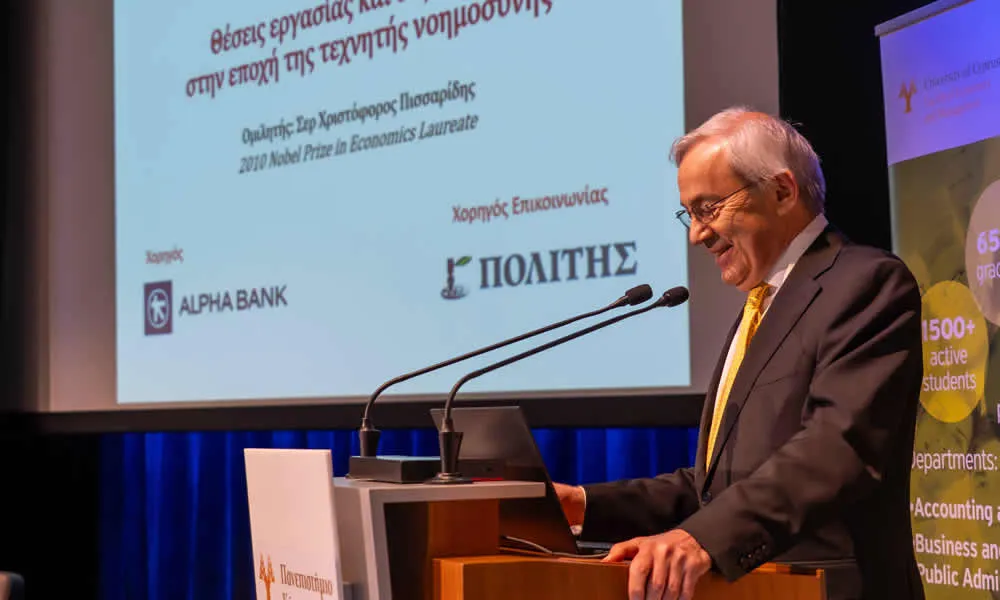
The future of work in the age of Artificial Intelligence was outlined by Nobel laureate economist Christopher Pissarides in his 11th annual public lecture at the University of Cyprus. The Professor noted that a smooth transition requires high-quality education, workplace training and lifelong learning.
Despite concerns that AI will leave "most people without jobs," Sir Christopher, Regius Professor of Economics at the London School of Economics and Professor of European Studies at the University of Cyprus argues that the history of technology does not support this scenario.
At a time when public debate around the world about Artificial Intelligence (AI) fluctuates between enthusiasm and alarmism, Nobel laureate economist Christoforos Pissarides, in his 11th annual public lecture at the Department of Economics of the School of Economics and Management at the University of Cyprus, sought to provide answers and a glimpse into the future through the lens of economic analysis and historical experience. The main sponsor of the event was Alpha Bank Cyprus and the media sponsor was the newspaper "Politis".
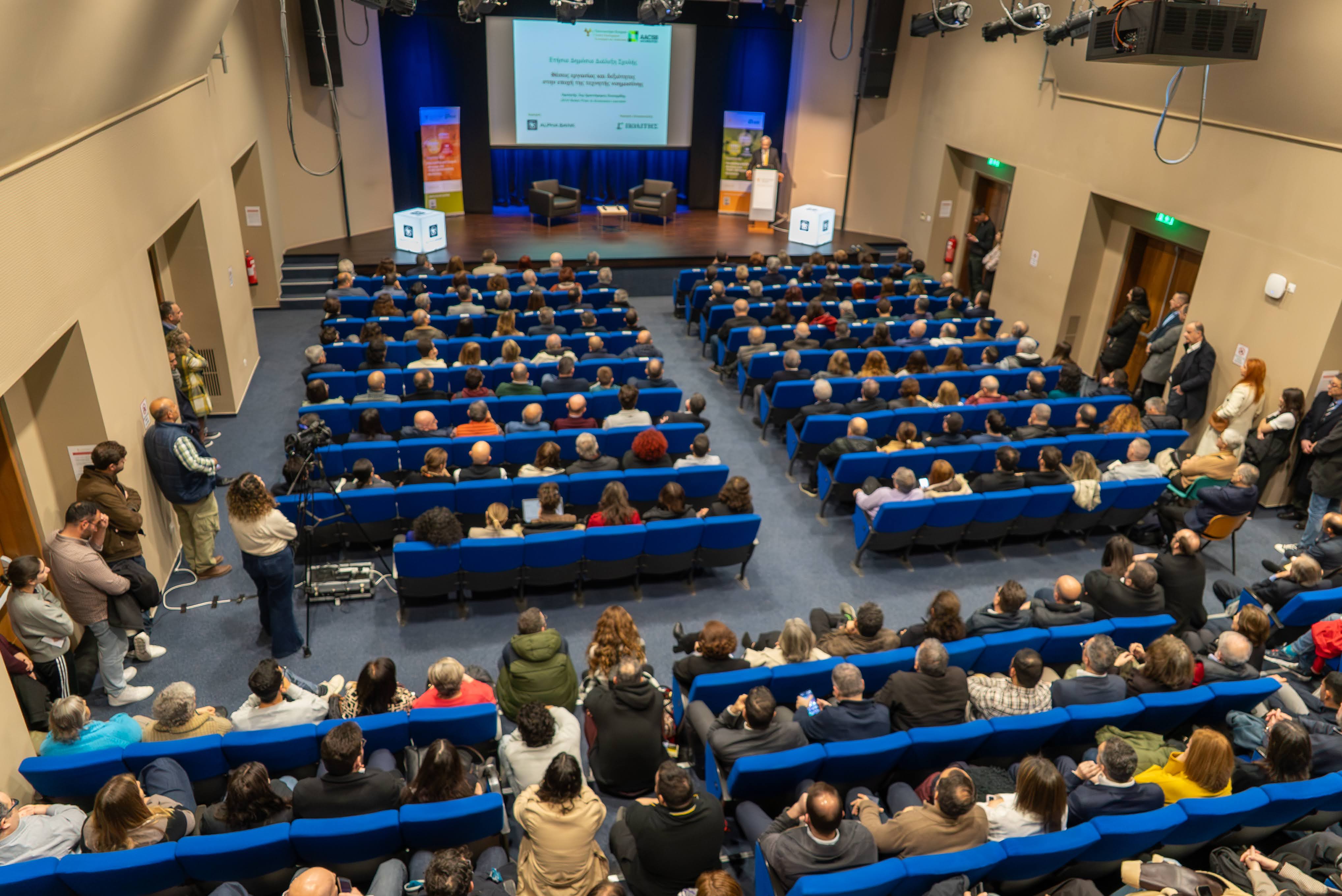
A full audience at the University of Cyprus Ceremony Hall listened with interest on Thursday evening for over an hour as Sir Christoforos Pissarides, also a professor at the Department of Economics at the School of Economics and Management at the University of Cyprus, spoke about the impact of AI on the labour market and, in that sense, on society.
His message was that AI will affect work, as has happened with other technologies since the Industrial Revolution. The greatest challenge, he said, is the smooth adaptation and transition of workers to new types of jobs. This transition is slowed, and for this reason a significant impact of AI on productivity has not yet been observed, by a lack of skills and "frictions", meaning resistance, such as a shortage of appropriate skills, uncertainty over which specialisations will be in demand, and the need for massive investments in energy, computing power and networks. Additionally, companies hesitate to make radical changes when the technological landscape is changing so rapidly.
The solution, according to Sir Christopher, lies in high-quality education, workplace training and lifelong learning. Translating his conclusions into policy terms, adapting to the AI era requires large-scale training of workers in new digital skills and a redesign of primary and secondary education curricula.
Work does not die
More specifically, in his speech Sir Christoforos Pissarides said that new technologies, as in the past, do not abolish work but transform it. He explained that Artificial Intelligence is already affecting the way many tasks are performed, automating individual duties or entire processes, while its overall impact on jobs depends largely on business strategy and the institutional and political framework.
He placed particular emphasis on the role of education, workplace training and lifelong learning, as well as on the need to develop "universal" human skills, such as critical thinking, data-driven decision-making, communication and emotional intelligence, which remain irreplaceable. These skills are not threatened by AI. As he stressed, the greatest challenge of the era is not the technology itself but the smooth and inclusive transition of workers to new forms of work.
Therefore, despite concerns that AI will leave "most people without jobs," Mr Pissarides maintains that past experience does not support this scenario. Every major innovation has destroyed jobs but has created new ones and transformed most of the rest. The result was a transformation of work rather than its end.
People, Sir Christopher said, do not choose idleness en masse when productivity rises. On the contrary, they seek new roles, often with better conditions.
Why AI is different
The Professor explained that Artificial Intelligence may be the most difficult technology economists have ever had to analyse, because for the first time technology does not simply replace physical strength but penetrates cognitive functions.
Unlike previous technological revolutions, such as electricity or mechanisation, where it was clearer which jobs would be affected, AI touches tasks in almost every profession. It does not necessarily abolish entire jobs but redistributes the individual duties and tasks that make them up.
A central idea in Pissarides’ analysis is that every job consists of many different tasks. Generative AI can perform some of these, often the more standardised, repetitive or informational tasks, but not all. With generative AI, the worker spends less time on routine tasks and more on judgment, creativity and coordination.
This "liberation" will accelerate with so-called AI agents, digital assistants that can take on complete missions, such as organising travel, comparing products and managing information. These tools increase productivity, acting as enhancers of capability rather than merely as replacement automation.
Mr Pissarides describes the desirable direction for AI as a complement to the worker. The question is not whether it will be used but how.
The puzzle of productivity
One of the most interesting points in Pissarides’ speech concerned the effect of AI on productivity growth, which has not yet been observed. This absence fuels concern among market analysts that the massive investments in AI infrastructure may not be profitable. Pissarides does not find this surprising. History shows that major technologies take time to deliver at the macroeconomic level because they require organisational changes, new skills, infrastructure investment and process redesign.
In the past, the widespread adoption of a technology preceded large productivity gains. The real boost comes when businesses reorganise around new capabilities, not simply when they purchase the new tool. He expects the same will happen with AI.
Inequalities
Contrary to the widespread view that AI will worsen inequalities, Pissarides sees the opposite dynamic. Because many AI tools are cheap and easy to use, they can empower individuals and countries with fewer resources, provided basic digital infrastructure is available. A professional in a poorer country can gain access to "cognitive power" that was previously the privilege of large organisations.
This does not mean that inequalities will disappear automatically. Without investment in education and infrastructure, the benefits will be uneven. However, technology itself does not necessarily have to work only for the few.