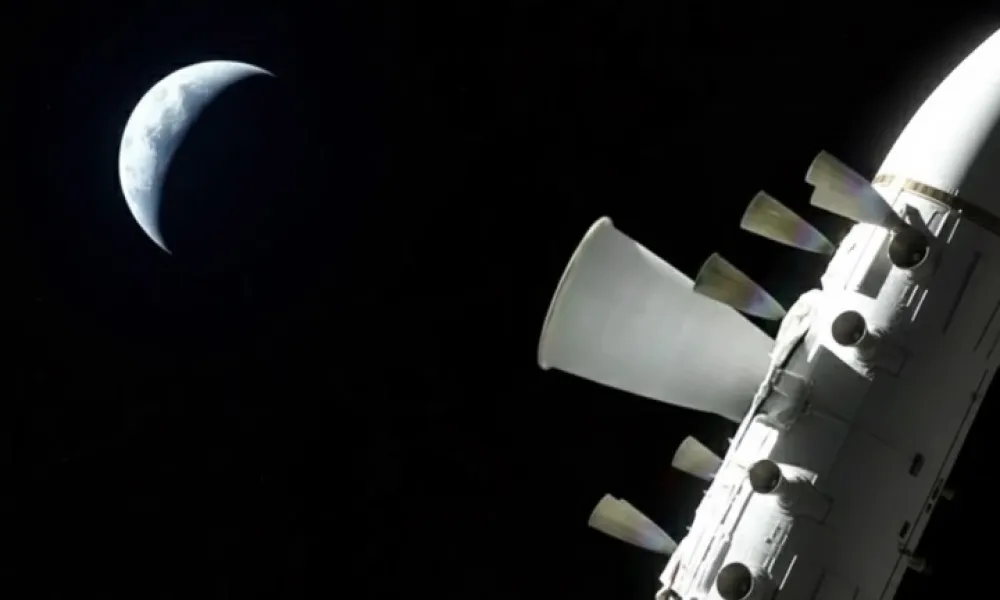

The Artemis II spacecraft is expected to return to Earth in the early hours of Saturday, Cyprus time, concluding a mission that has advanced plans for renewed human exploration of the Moon and beyond.
With four astronauts on board, the NASA mission travelled as far as 400,171 kilometres from Earth, the greatest distance reached by humans in more than 50 years. The crew also observed the far side of the Moon, surpassing a record set by Apollo 13 in 1970.
NASA astronauts Reid Wiseman, Victor Glover and Christina Koch, along with Canadian Space Agency astronaut Jeremy Hansen, are now preparing for re-entry following their lunar flyby.
Final preparations are under way for the spacecraft’s return. The crew is securing equipment, adjusting seating and completing system checks ahead of descent. They are also reviewing weather conditions, recovery operations and the re-entry timeline, as well as post-landing procedures.
Orion’s thrusters are scheduled to fire for a second trajectory correction burn to refine its course back to Earth. During the manoeuvre, Hansen will monitor the spacecraft’s guidance, navigation and propulsion systems.
Re-entry is expected at 17:07 PDT on Friday off the coast of San Diego, corresponding to 03:07 Cyprus time on Saturday. The service module will separate around 20 minutes before Orion reaches the upper atmosphere southeast of Hawaii.
The spacecraft is expected to reach speeds of about 23,864 miles per hour shortly before re-entry. As it descends, Orion will enter a planned communications blackout lasting around six minutes due to plasma forming around the capsule during peak heating. The crew is expected to experience forces of up to 3.9 G.
After exiting the blackout, the capsule will deploy its parachutes, beginning with the forward bay cover, followed by drogue parachutes at around 22,000 feet and three main parachutes at approximately 6,000 feet to slow the descent before splashdown.
Within two hours of landing, the crew will be recovered by helicopter and transferred to the USS John P. Murtha. They will undergo medical checks before returning to NASA’s Johnson Space Center in Houston.
What comes next
NASA plans a further mission in 2027 to test system capabilities closer to the lunar surface, ahead of a crewed landing for the first time in more than 50 years. The programme also aims to establish annual lunar missions and send astronauts to explore the Moon’s south pole by 2028.
Cyprus role
Cyprus is also involved in the Artemis programme through collaborations led by the Cyprus Space Exploration Organisation. Research conducted with the Cyprus Institute of Neurology and Genetics has explored potential pharmaceutical approaches to address health challenges faced by astronauts during long-duration missions.
The Artemis programme aims to establish a sustained human presence on the Moon and support future exploration missions, including journeys to Mars.