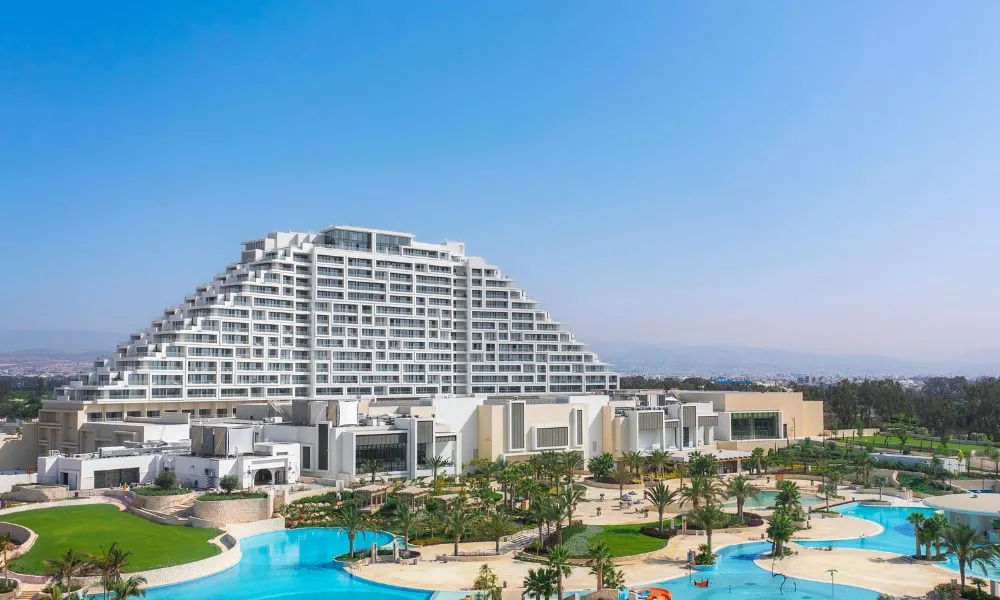

The Integrated Casino Resort in Limassol and the three satellite casinos in Nicosia, Ayia Napa and Paphos recorded impressive growth in gross gaming revenue (GGR) in 2025, boosting public revenue from taxes and licence fees. The investment is considered pivotal for diversifying Cyprus’s tourism model and attracting visitors year‑round.
According to figures included in the annual report of the Gaming and Casino Supervision Authority submitted to the Deputy Minister to the President, Irene Piki, by the Authority’s president Pieris Chourides, vice‑president Marios Pieris and executive director Haris Tsaggari, gross gaming revenue reached €227 million in 2025, up from €189.2 million in 2024, an increase of 20%.
From June 2018 to July 2024, cumulative revenues exceeded €529.7 million. In 2025, 86% of GGR originated from Limassol, 8% from Nicosia, 3% from Paphos and 2% from Ayia Napa.
In his introductory note, the president of the Authority, Pieris Chourides, notes that this development is linked to the stability of the institutional framework, consistent supervision and the creation of conditions of transparency and trust, which support the sustainable development of the land‑based casino sector.
By the end of 2025, active registered players, defined as those who played at least once in the previous 12 months, totalled 65,989, up from 55,137 in 2024 and 46,599 in 2023. The increase is attributed to the operation of the Integrated Casino Resort and the attraction of players from abroad. International players significantly outnumber Cypriots, more than four times as many in 2024 and six times as many in 2025.
Revenue for the state
Significant revenues also accrue to the state. Casino tax revenue, calculated at 15% of GGR, amounted to €34.05 million in 2025, €28.3 million in 2024 and €19.5 million in 2023.
In addition, annual licence fees amount to €2.5 million for the first four years of operation and €5 million for subsequent years. The permanent operating licence for the Integrated Casino Resort was granted in 2023.
Supervision
As regards supervision, the Authority applies a risk‑based model, with hundreds of scheduled and unannounced inspections, technical checks on machines and real‑time monitoring through data analytics.
The financial compliance team cross‑checks monthly GGR declarations against accounting and audit reports and, as the competent authority for the prevention of money laundering, enforces strict KYC requirements and transaction monitoring. Sanctions are imposed for violations, ranging from corrective recommendations to licence suspensions.
In terms of player protection policies, the Authority and the casino operator apply a framework of measures including self‑exclusion mechanisms, participation limits and targeted interventions for high‑risk players. According to the report, dozens of self‑exclusion measures were activated, with related requests showing an upward trend compared to previous periods.
At the same time, awareness‑raising and information actions were implemented, both within casino premises and through digital channels, aimed at enhancing players’ understanding of addiction risks. These actions include the provision of informational material, staff training to recognise problematic behaviour and cooperation with specialised bodies.