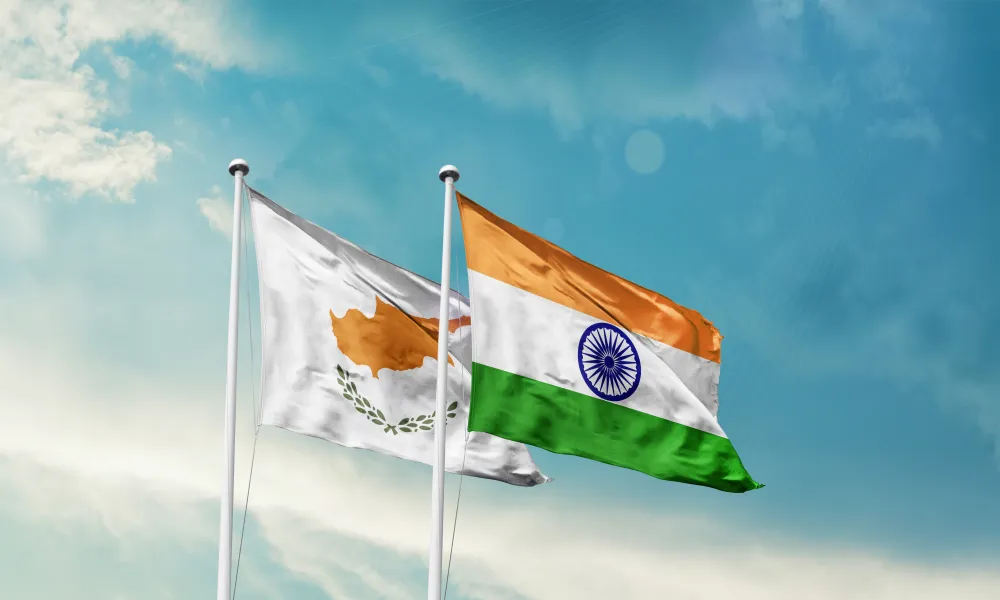

The turbulence reshaping the Middle East is generating an unexpected opening for Cyprus. As international reports document capital outflows from Gulf states, with Switzerland emerging as a primary destination, the island is making a case for itself as a stable, EU-based alternative for businesses and investors seeking a foothold in the European market. The effort to build new commercial relationships in Asia, with India as the central target, is beginning to yield results.
The most tangible example is the imminent opening of a Eurobank representative office in Mumbai, the financial capital of India. Panagiotis Chrysostomou, Director of Banking Services and Representative Offices at Eurobank Limited, the Cypriot subsidiary of the Eurobank Group that is leading the India initiative, told Politis that the current geopolitical moment is creating a genuine opportunity. "Cyprus is a safe, alternative business destination that offers significant advantages to foreign companies and investors," he said. "We are seeing momentum over the past year in the India-Cyprus relationship. India is a very promising market with great prospects, and opening up to it is an opportunity for Cyprus."
Chrysostomou said the Mumbai office is designed to function as a hub connecting large Indian companies seeking a presence in Europe with Cypriot and Greek businesses looking to enter the Indian market. "Traditionally, there has been a significant Indian presence in Gulf countries, and it is natural that they are now weighing their options," he added. Eurobank plans to follow the Mumbai office with representative offices in Israel, Abu Dhabi and Saudi Arabia in subsequent stages.
President Christodoulides to visit India in May
The diplomatic track is moving in parallel. President Nikos Christodoulides is scheduled to visit India in the third week of May, with the trip focused on promoting Cyprus as an investment-friendly destination for Indian companies seeking access to the European single market.
The IMEC corridor
A further strategic dimension is provided by the India-Middle East-Europe Economic Corridor, known as IMEC, an ambitious connectivity initiative that remains active despite the geopolitical pressures bearing down on the region. The corridor aims to create an alternative trade and energy axis linking India to Europe via the Middle East, elevating the strategic importance of Eastern Mediterranean hub countries. President Christodoulides referenced IMEC in an interview with the Associated Press given ahead of this week's informal EU summit in Cyprus.
Under the Cypriot Presidency of the Council of the EU, a "Friends of IMEC" group has already been established to advance the initiative and identify concrete projects. For Cyprus, tapping into IMEC's potential translates into opportunities in logistics, shipping, energy and technology, as well as a stronger role as a regional services hub, with accompanying prospects for infrastructure development and enhanced connectivity.
The path is not without obstacles. Competition from other European and regional jurisdictions is intense, and the need to improve the business environment, the speed of the justice system and the efficiency of public administration remains pressing.