
By the summer of 1974, Michael Cacoyannis was already one of the most celebrated filmmakers in the world. Nineteen years earlier, in 1955, his masterpiece Stella had won the Golden Globe for Best Foreign Language Film. He was at the height of his creative powers. Zorba the Greek (1964) had earned seven Academy Award nominations, and he had already received dozens of honours for his film and theatre productions. Working with some of the biggest names in Greek and international cinema, Cacoyannis was, beyond doubt, the most successful and widely recognised Cypriot artist of his era.
The coup and the Turkish invasion of Cyprus in the summer of 1974 found him in Ireland, where he was preparing a production of Oedipus for the country’s National Theatre. Deeply shaken by events in his homeland, Cacoyannis halted rehearsals and travelled to Cyprus. In September, he began filming Attila 1974 – The Rape of Cyprus, a documentary that would become one of the most important visual records of the island’s modern history.
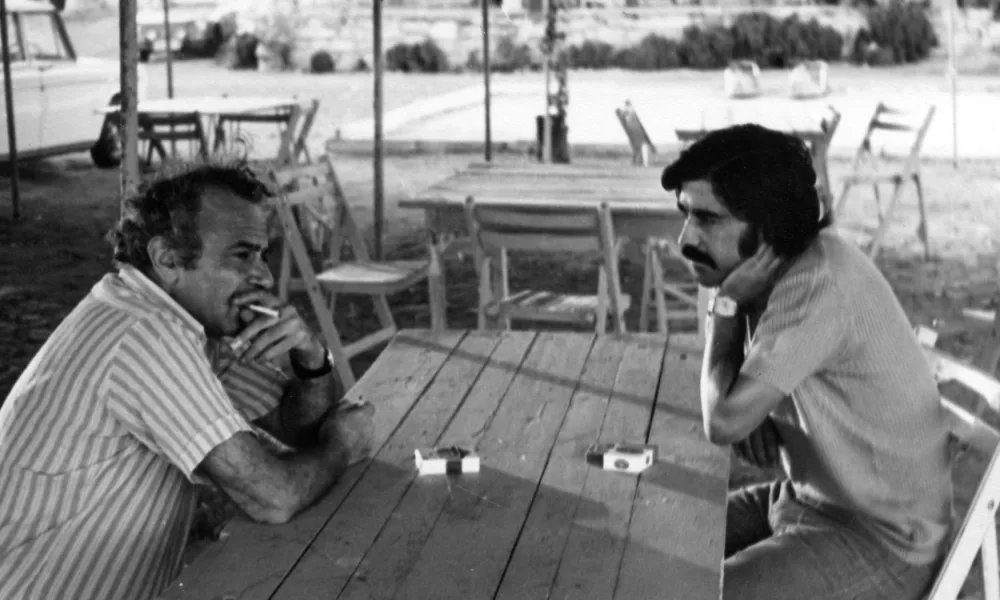
Photographs from the production show Cacoyannis alongside journalist Pavlos Pavlou in the Achna woodland, where many displaced people had sought refuge during filming.
In the moment
“Until then, I knew Michael Cacoyannis only from afar,” Pavlou told CNA. “I regarded him with awe, as the great Cypriot whose successes in cinema had made him internationally famous.”
Pavlou was recruited as an assistant on the production, accompanying the director throughout the filming process.
What makes Attila 1974 unique is that it was shot as events were unfolding.
“The great historical value of this documentary is that it records the tragedy of Cyprus through the eyes of a world-famous director and through a purely documentary approach, while memories, suffering and uncertainty were still entirely raw,” Pavlou said. “People were living under trees or in makeshift camps. No one knew what would happen next. Most believed they would return home within a week or two. The tragedy was unfolding before our eyes and before our cameras.”
Originality of work
According to Xenia Pirounia, a doctoral candidate at the Department of Fine Arts and Art Sciences at the University of Ioannina, this real-time dimension is one of the documentary’s defining features.
“The great originality of Cacoyannis’ work is that he films the documentary at the exact moment the events are taking place,” she said. “It is a real-time recording, and this determines the way he uses his material. There is no predetermined script and no heavy equipment. It appears he had not even decided precisely where or what he would film. He wanted the flexibility to move across the whole of Cyprus and capture events as faithfully as possible.”
Improvisation
Pavlou recalled that the documentary format itself represented new territory for Cacoyannis, whose previous experience had largely been in feature films and theatre.
Having completed studies at the BBC Production School in London a year earlier, Pavlou meticulously logged every scene that was filmed, recording dates, times and locations.
“Cacoyannis was highly emotional and worked without a clear script,” he said. “He relied on his immense talent and improvised to a large extent. When filming ended and he left for Athens for the editing process, I handed him all my notes. Years later, his sister, Yiannoula Cacoyannis Wakefield, thanked me, saying: ‘Come here, you. Without your notes, we would never have managed to make sense of all that material.’”
Personal testimony
Pirounia argues that the documentary’s deeply personal tone stems from the fact that it was conceived as a personal testimony rather than an exercise in detached historical observation.
“The film opens with the note, ‘A testimony on film by Michael Cacoyannis’,” she said. “From the outset, it presents itself as a personal witness account recorded through a camera rather than on paper. Cacoyannis abandons any claim to objectivity. He inserts himself into the filming process. We see him conducting interviews, and we hear his voice.”
These elements, she noted, are characteristic of Cinéma Vérité, the French documentary movement that emerged in the 1960s.
“By 1974, the military dictatorship in Greece had just collapsed, ending years of cultural isolation from international artistic movements,” she said. “What filmmakers such as Theo Angelopoulos and Vasilis Rafailidis were beginning to pursue through contemporary cinema, Cacoyannis attempted through this documentary.”
Human cost
Although Attila 1974 is often remembered for its high-profile political interviews, particularly that of Archbishop Makarios III, its primary focus remains the human cost of the conflict.
“That is one of its most important features,” Pavlou said. “The film, narrated by Cacoyannis himself, was screened in many countries and highlighted not only the political dimension of the Cyprus issue but also the human suffering endured by ordinary people. He approached the tragedy through that lens, even interviewing young children.”
He noted that cinematographer Sakis Maniatis repeatedly focused on the eyes of interviewees, revealing “all the grief and trauma they carried”.
Historian Tasos Sakellaropoulos emphasised the significance of the period captured by the documentary.
“Cacoyannis speaks with Greek Cypriots who have been uprooted from their homes. He records makeshift graves and burials and documents the anguish surrounding the missing persons,” he said. “This is the very earliest phase of post-invasion Cyprus, when refugee camps and displaced families dominated the landscape. It is profoundly moving. Cacoyannis captures and preserves the beginning of the Cyprus problem as it evolved and persisted over the decades that followed.”
Microhistory
Pirounia places the work in a broader theoretical context.
“It stands at the crossroads between Cinéma Vérité and the personal film essay,” she said. “Cacoyannis gives particular weight to the testimonies of ordinary people, those on whose lives and bodies history was written. He gives every family and every individual a voice. He creates close-up portraits, attends funerals, records public anger and visits the homes of families of the missing. Today we would describe this as microhistory and oral history. He recorded it at the very moment it was happening.”
The Makarios interview
Sakellaropoulos highlighted another key historical dimension: the interview with Archbishop Makarios.
“One of the most remarkable aspects of the documentary is that Cacoyannis secured an interview with Makarios himself,” he said. “What matters is not only the questions but also the way he answers them. His devastation is visible. This is a man taking stock of events in a way completely different from the confidence he projected before July 1974.”
According to Sakellaropoulos, the archbishop appeared deeply marked by the catastrophe that followed the coup and invasion.
“He seems to recognise that he, too, played a role in the developments,” he said. “Above all, he had believed Cyprus was protected by international agreements, only to discover that those safeguards were inadequate.”
The documentary also captures the political tensions and ideological divisions of the time.
EOKA B
Pavlou recalled one particularly striking interview with a member of EOKA B in Platres.
“Cacoyannis asked him whether, looking back at the consequences of the coup, he would rather be governed by the Turks or by the Left,” Pavlou said. “His answer was: ‘The Turks.’”
Sakellaropoulos said the exchange reflected the mentality and ideological convictions of many EOKA B supporters and Greek military officers of the period.
“They believed Makarios was a communist, or that he was paving the way for communism, when in reality he was anti-communist,” he said. “It was an ideological fixation. The destruction of Cyprus did not arise solely from anti-Makarios Greek Cypriots. It was also linked to a Greek military establishment shaped by a deeply anti-communist and ultimately destructive mentality.”
‘Directed by history’
In his final interview, given to P. Panayi in 2010, Cacoyannis reflected on the film’s enduring significance.
“Attila ’74 was not a film directed by me,” he said. “It was directed by history itself. I merely recorded the events.”
The observation echoes the title of the final essay by French sociologist Edgar Morin, a co-founder of the Cinéma Vérité movement: Does History Teach Us Lessons?
More than half a century later, Attila 1974 continues to pose that question with persistence, honesty and profound humanity.
Source: CNA