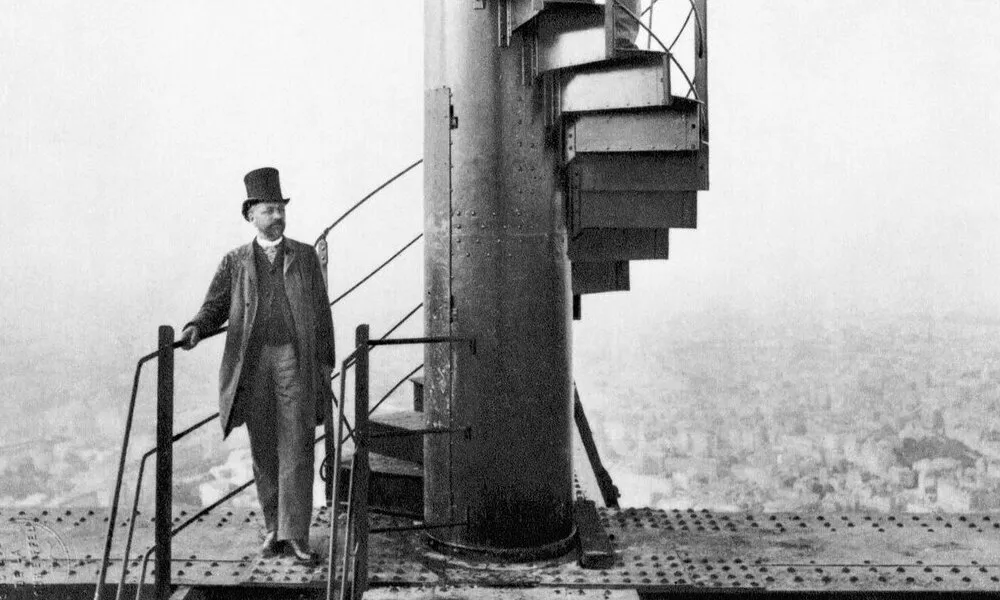
Next May, a section of the Eiffel Tower's original spiral staircase will go up for auction in Paris, giving one buyer the rare opportunity to own a fragment of one of the world's most recognisable structures.
The staircase was part of the tower as Gustave Eiffel designed and built it for the 1889 World's Fair, providing access from the second level to the summit. In 1983, as part of a modernisation project, the stairs were dismantled to make way for elevators and divided into 24 sections. Four were donated to museums and 20 sold at auction. The piece now heading to sale, which stands roughly 2.7 metres tall and comprises 14 steps, has been held in private storage for more than 40 years by a French businessman who has not been identified. It was recently restored by the same artisans responsible for the ongoing maintenance of the tower.
The auction house Artcurial, which is handling the sale, estimates the piece at between €120,000 and €150,000. The figure may yet prove conservative. In 2016, another section of the same staircase sold at Artcurial for €523,800, a record the house is openly hoping to surpass. Sabrina Dolla, a director at Artcurial, described the piece as "a true testament to the history of the Eiffel Tower and, beyond that, to universal history," and said she had "every reason to be ambitious" about the final price. She also noted that this particular section was the first to be sold in the original 1983 auction, meaning its first buyer had to summon, as she put it, "a certain amount of courage to be the first to enter the battle."
The tower itself was not always the object of reverence it is today. Before construction was even complete, prominent French artists and writers condemned it as "useless" and "monstrous." The controversy faded as the engineering achievement became undeniable, and the structure has since become one of the most visited monuments in the world, drawing around seven million visitors a year.
Of the 24 sections sold in 1983, several have remained in France, with pieces held at the Musée d'Orsay and the Cité des Sciences in Paris. Others have travelled further: one is displayed near the Statue of Liberty in New York City, and another stands in the gardens of the Yoishii Foundation in Japan. Dolla expects the upcoming auction to draw international interest from private collectors, cultural institutions and companies alike.
Source: The New York Times