Two major art exhibitions were officially opened on Tuesday at the European Parliament in Brussels, as part of Cyprus’ Presidency of the Council of the European Union.
The exhibitions are titled “Nicosia International Airport” by photographer Andros Efstathiou and “Growing Self” by visual artist Maria Leonidou. They are presented under the cultural programme of the Cypriot Presidency and aim to link collective memory with future perspectives.
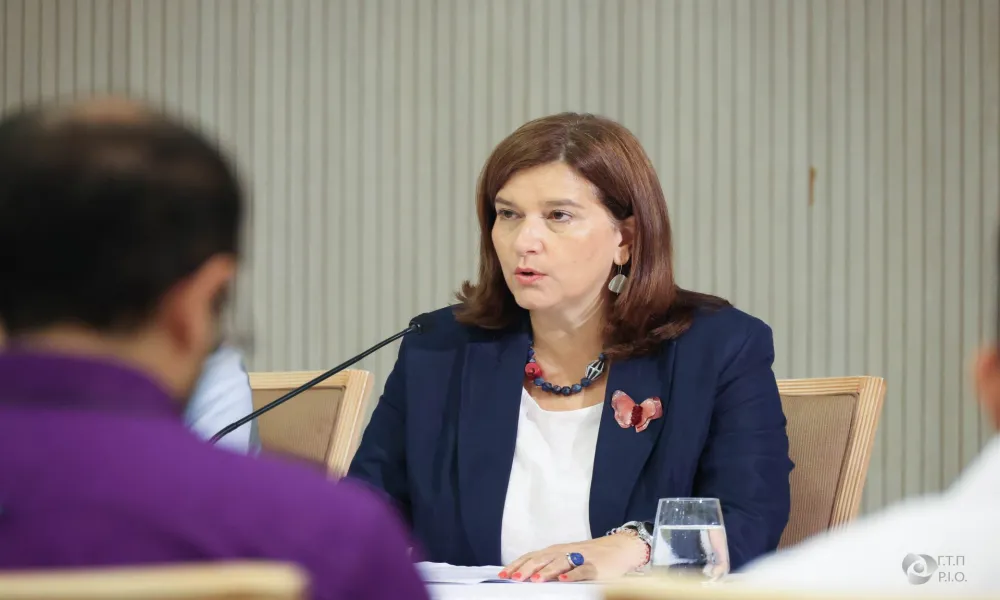
Speaking at the opening ceremony, Cyprus’ Deputy Minister of Culture, Vasiliki Kassianidou, said the two exhibitions were selected to create an interaction between shared memory and the search for a common future. She said culture plays a central role in shaping European identity and policy.
She stated that through the Presidency, the Republic of Cyprus seeks to strengthen cohesion and strategic unity within the European Union. At the same time, it aims to promote cultural innovation and sustainable cooperation among member states.
Kassianidou stressed that particular emphasis is placed on safeguarding the Union’s fundamental values. These include respect for human dignity, freedom, democracy, equality and the rule of law.
She said the Presidency also aims to reinforce the role of culture as a pillar of European policy. This includes linking cultural development with democratic values across the Union.
Referring to upcoming policy work, she said discussions will take place within the Cultural Affairs Committee and the Working Group on Audiovisual and Media. These discussions will focus on the legal basis of the new AgoraEU funding regulation. The new regulation will replace the current Creative Europe and CERV programmes and is intended to support cultural mobility and activity across Europe.
She added that the Presidency will also promote a new legal framework for the European Capitals of Culture. It will also support the adoption of the Cultural Compass, a strategic tool designed to help build strong cultural ecosystems in the future, including through the use of new technologies.
Kassianidou said Cyprus will contribute actively to the implementation of the European Media Freedom Act. She explained that this includes creating space for dialogue on the protection of cultural rights and tackling the illegal trafficking of cultural goods.
She said this approach aims to ensure a stable and fair framework for the protection and development of culture across Europe.
The Deputy Minister noted that culture is not limited to artistic or aesthetic expression. She said it is fundamental to identity, memory and the creation of a shared European outlook.
Turning to Andros Efstathiou’s exhibition, she said the abandoned Nicosia International Airport is presented as a symbol of memory, resilience and hope. She explained that through a theatrical photographic approach, the work revisits the last flight before the Turkish invasion of 1974. The exhibition connects physical space with memory and invites reflection.
On Maria Leonidou’s exhibition “Growing Self”, Kassianidou said it draws inspiration from the past while engaging with technology and imagination. She said it explores contemporary identity and presents art as a process of renewal and transformation.
She added that the two exhibitions are in dialogue with each other and with Europe itself. She said they reflect a journey from memory to change, and from a defining past to a collectively shaped future.
Concluding her address, she said the Cypriot Presidency aims to continue this dialogue by strengthening cultural cooperation, innovation and the protection of cultural heritage. She said Europe continues to draw strength from memory while moving towards a shared future based on solidarity, democracy and culture.
Speaking about his work, Andros Efstathiou said he felt the need to document what he described as the silent stillness of Nicosia International Airport.
He said the airport, built in 1968, was a landmark of modernist architecture. He described it as a symbol of openness, movement and connection.
He said that in July 1974, the airport fell silent. Today, he described it as a frozen space, not between past and present, but between people.
Efstathiou explained that the people shown in his photographs are not symbolic figures. He said they are the crew of the last flight that landed at the airport in 1974. They were photographed wearing their original uniforms more than four decades later.
He said presenting this work in Brussels places Cyprus’s memory within a wider European context. He added that history, responsibility and remembrance remain closely linked at a European level.