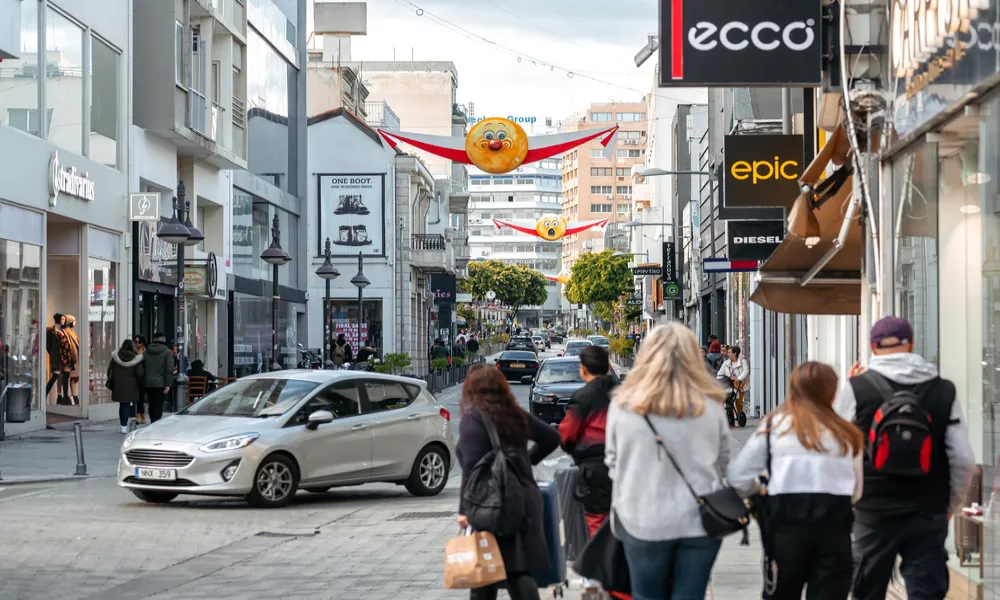

Once again in Limassol, a major debate has reopened over the future of the city’s main commercial artery, Anexartisias (Independence) Street. Over the years, the discussion has moved through consultations, studies, debates, ideas and proposals, yet without producing a final outcome that would lead to the works needed to shape the street’s future.
The latest development came about two months ago, when Limassol Municipality appointed the project’s consultants through an open tender process. The consultants have now launched a process that is pioneering by Cypriot standards, combining public consultations with co-design workshops. Through this largely open dialogue, what is being billed as the “new Anexartisias Street” is expected to emerge.
Today, Anexartisias Street remains a commercially successful road for its shop owners. They acknowledge problems, but argue that the street is performing well, attracts customers and continues to lure new businesses, including major international brands. At the same time, a stroll along the street reveals a number of vacant shops, many of them empty for years, as owners persist in demanding extremely high rents.
The big question is whether Anexartisias Street should become pedestrianised or operate as a one-way road. Most Limassol residents appear to favour pedestrianisation, based on responses in earlier consultations. Shop owners, although initially opposed to any change, have adjusted their stance and now propose a one-way street with wide pavements, greenery and shading. From there on, however, complications arise over traffic direction and the availability of peripheral parking.
Any major intervention clearly requires a comprehensive support network. Yes, peripheral parking must be created, but “peripheral” does not mean fifty metres away. Those most affected should focus on ensuring that whatever works are planned are carried out in an organised and well-managed way, with minimal disruption. Even the best Anexartisias Street will fail if it remains closed for two or three years. The project must proceed in phases, with double shifts and as little disturbance as possible, especially during peak periods such as Christmas.
Anexartisias Street currently has greenery only in a few spots, and forgive me, but pots on pavements are more of a nuisance than real green space. The pavements are narrow and in poor condition, lighting is inadequate, and constant traffic creates noise and disruption. I will not compare the street to the mall, because a city like Limassol can sustain both.
For me, the issue is simple and relates to the philosophy that should guide urban interventions today. Limassol suffers acutely from a lack of public spaces and greenery. It also struggles with severe traffic congestion, yet some still insist on planning change around the car. We persist in treating our city as a “special case”, as if it were the only city in the world with high temperatures and a car-dependent mindset. With such approaches, progress is impossible. Change may unsettle some, but dismissing practices that are internationally recognised is, at best, misguided.
If we accept that commerce itself has changed, that is a good starting point. We should also recognise that cars do not shop. Who are today’s customers, not just on Anexartisias Street but everywhere? They are people who walk, browse shop windows, interact, spend time in a place and eventually make purchases. The key issue is how people reach Independence Street or other commercial centres. That will never change as long as we keep allowing cars to push into the centre in the hope of finding a parking space.
In Limassol, before the Olympic Coast, the promenade, the marina and the old port were built, people did not walk. Once infrastructure was created, they embraced it and came to love the area as Cyprus’s most attractive urban space. The same can happen on Independence Street. When people are given options and the right infrastructure, they will walk. As long as infrastructure prioritises cars, we will remain trapped inside them. Anexartisias Street can flourish. Pedestrianisation is a bold step that the city needs. Let us take it, even if gradually.