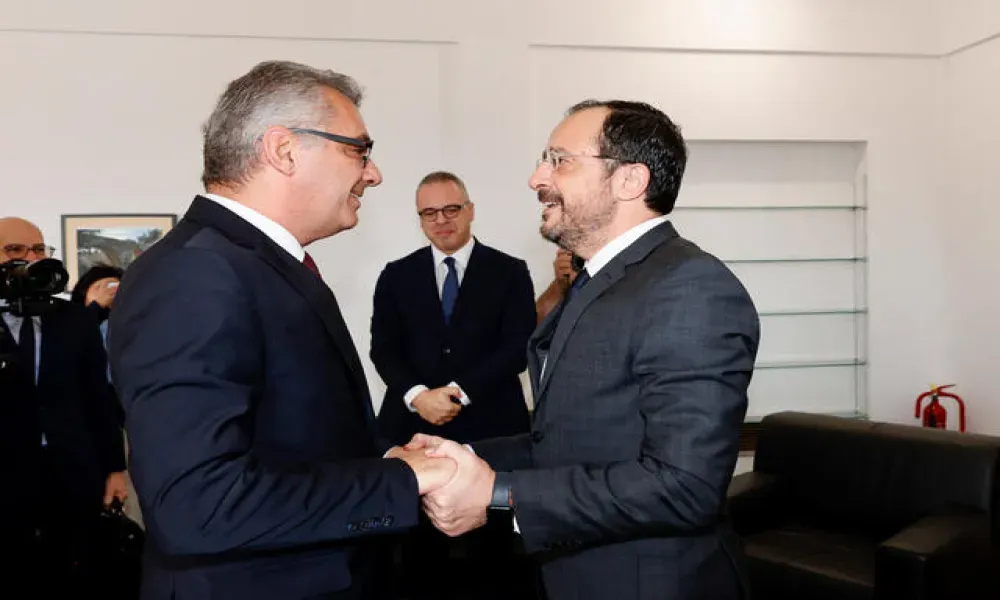

Little is expected to emerge from the upcoming meeting on Friday between the two community leaders in Cyprus, just a month after their last encounter in early April. Despite the renewed contact, there is still no clear sense of a shared framework for action, particularly regarding confidence-building measures (CBMs), and no indication so far of convergence on key issues such as the opening of new crossing points.
Diverging views on the negotiation process
Recent statements from both sides also highlight a widening gap over how the process itself should be understood.
On the one hand, Greek Cypriot leader Nikos Christodoulides argues that the UN Secretary-General is already engaged in discussions on substantive issues. On the other, Turkish Cypriot leader Tufan Erhürman maintains that any meaningful substantive dialogue will only begin once the Cyprus presidency cycle is completed, under the leadership of the Secretary-General.
No progress on confidence-building measures
Following their last meeting in April, a UN statement indicated that the two leaders had instructed their negotiators to continue discussions in order to finalise issues that could potentially be agreed, paving the way for joint announcements at a future meeting.
However, current information suggests there is no breakthrough on CBMs, particularly on the issue of new crossing points. Statements from the Turkish Cypriot side in particular indicate continued disagreement over the four proposed crossings currently under discussion.
Tense climate ahead of 6 May meeting
The upcoming meeting on 6 May is taking place in a less favourable climate, with recent statements from both sides contributing to tensions. Developments in the buffer zone, particularly in Pyla, have also added strain to the atmosphere.
Despite this, the meeting is still seen as an opportunity to clarify positions, while attention is also turning to the UN Secretary-General’s next steps and potential renewed engagement by his envoy, María Ángela Holguín, who is awaiting approval to return to Nicosia.
UN pushing against further delay
UN officials have repeatedly stressed that time is not on the side of the process. Holguín has reportedly been urging both sides to move forward, reflecting concerns within the UN that further delays could undermine prospects for progress.
There is also anticipation that the Secretary-General may outline a broader initiative in early July, depending on developments on the ground.
Parallel positions with no common starting point
At present, Christodoulides and Erhürman appear to be operating on parallel tracks, not because engagement is impossible, but because neither side is currently willing to adjust its approach.
The disagreement goes beyond individual issues, extending even to the definition of what the process itself entails. One side speaks of “progress” and “momentum”, while the other describes informal contacts without genuine negotiating character.
Competing narratives around UN involvement
The Greek Cypriot leadership has sought to link current efforts to a broader UN-led initiative under António Guterres. However, this framing has yet to be accompanied by clear parameters or defined steps, leaving the impression of movement without a concrete framework.
Meanwhile, reports suggest the UN Secretary-General has secured Turkish approval for a renewed initiative and is considering options including a strategic framework document or, alternatively, a phased approach involving a looser federal structure proposal.
Erhürman under pressure over stance
Erhürman, for his part, continues to avoid framing the situation as formal negotiations, arguing that no binding process is currently in place. He has also criticised Greek Cypriot statements as attempts to create faits accomplis.
At the same time, he faces increasing domestic and academic pressure to adopt a more proactive role. Critics argue that while he is cautious about entering talks without political equality guarantees, he is also aware that partition is not seen as a viable long-term outcome.
A cycle that sustains itself without resolution
Ultimately, the two approaches remain disconnected but mutually reinforcing. One side presents progress in the process; the other denies that a process exists at all.
As long as this divergence continues, the Cyprus issue risks remaining locked in a cycle that generates neither convergence nor resolution, but instead sustains uncertainty and competing narratives.
This article was originally published on the Greek-language Politis website.