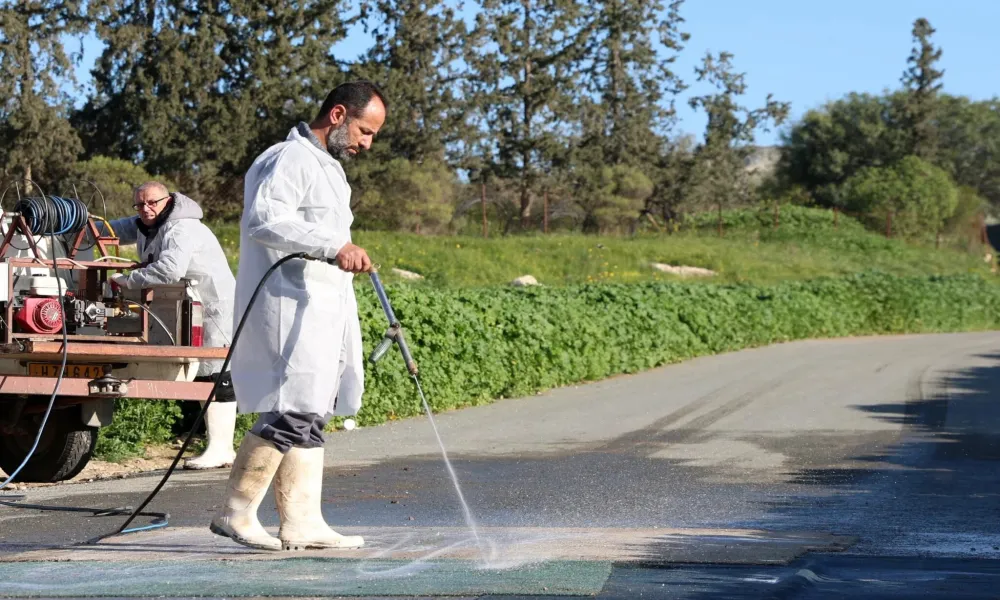
Agricultural organisations have called for the measures imposed by the European Union in the government-controlled areas of Cyprus to also be applied in the occupied areas, according to statements made by their representatives to the Cyprus News Agency. They also noted that the culling of animals continues as part of efforts to contain the outbreak of foot-and-mouth disease.
The President of the Association of Sheep and Goat Producers, Sotiris Kadis, told CNA that culling operations are ongoing, adding that farmers want the same measures imposed by the EU in the government-controlled areas to also apply in the occupied areas. “If this does not happen, we are all in a minefield,” he said.
The President of the Panagrotikos Farmers’ Union, Kyriakos Kailas, also told CNA that the required measures must be implemented and that there is no alternative course of action.
“Beyond that, we also requested, as we did during our meeting with the President of the Republic, that the crossing points be closed for several months. Saying that strict monitoring will take place is not enough, because it is impossible to control who visits a farm, buys something and then transports the virus into the government-controlled areas,” he added.
Responding to a question, Mr Kailas said strict measures are already being applied at livestock units, noting that the aim is to protect as many farms as possible.
He said animals will inevitably be culled and livestock units lost, but farmers are expected to receive full compensation, including for loss of income. He added that these are the Government’s stated intentions and described them as moving in the right direction.
Mr Kailas said compensation should not only cover the value of animals, which can vary depending on breed, but also other losses, including destroyed feed, milk that had to be discarded and broader economic losses suffered by farmers. He also referred to the commitment made by the President of the Republic regarding compensation for loss of income over a six-month period.
He noted that replacing livestock cannot happen immediately, as newly imported animals must first reproduce before production can resume. “They will become pregnant, give birth and only then will we start milking and generating income again,” he said.
Mr Kailas added that animals could be imported and vaccinated upon arrival in Cyprus, followed by a second vaccination four weeks later in order to develop antibodies and strengthen resistance to the virus.
He explained that livestock populations are normally renewed gradually rather than all at once, noting that farmers typically replace around 25% of their herds annually to maintain stable production.
Mr Kailas also said the public must be convinced that the measures being implemented are necessary. “People are worried,” he said.
Mr Kadis reiterated that the same restrictions should apply in the occupied areas, arguing that uneven implementation increases the risks.
“For example, I am in the Athienou area, 10 kilometres from the latest outbreak and just 1.5 kilometres from the occupied areas. Where should I focus my precautions?” he said.