
After a Shahed‑type drone landed on the British base at Akrotiri on March 2, Cyprus moved quickly to try and find ways to fill the security gap. Five EU member states and the UK deployed military assets to the island. In response, Turkey sent F‑16s to the north. Nicosia raised the issue of renegotiating the status of the British Bases and, as EU Council president, put the operationalisation of Article 42.7 – the EU’s mutual defence clause – on the agenda.
The issue was discussed at the informal EU summit in Cyprus, also attended by regional leaders from Egypt, Jordan, Lebanon and Syria. Cyprus’ pivot towards deeper Western alignment has enhanced its profile as the EU’s easternmost outpost, even as it remains divided, outside NATO and without formal security guarantees.
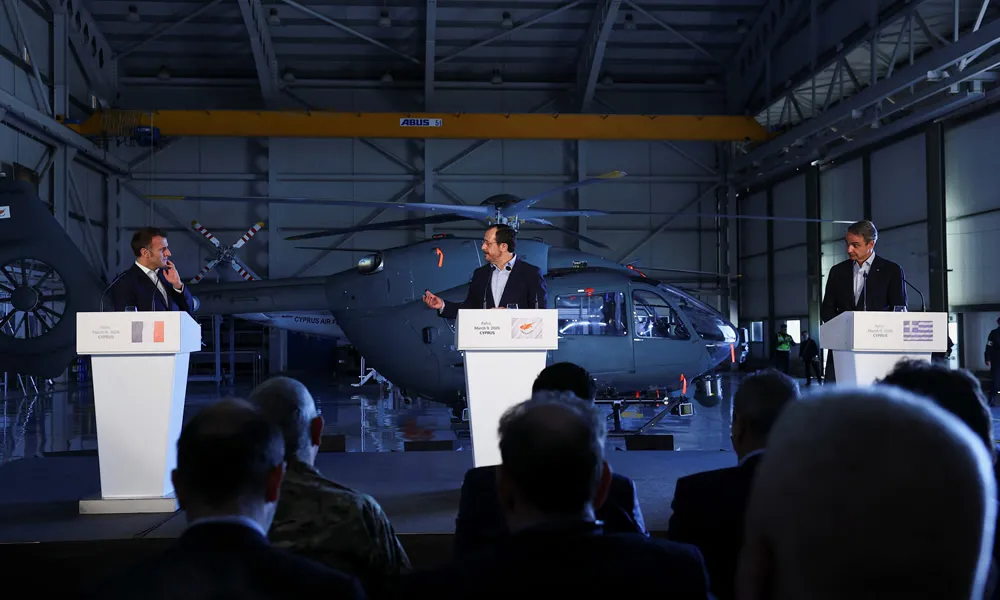
France, Greece and Cyprus have emerged as leading advocates of EU strategic autonomy. On signing a strategic partnership agreement with Cyprus in December 2025, French President Emmanuel Macron said the bilateral partnership underscored “our commitment to being even more present alongside you in the eastern Mediterranean”. When recently in Cyprus, he referred to the deployment of a French carrier group after the drone incident, saying: “When Cyprus was attacked, it was Europe which was attacked.”
In Athens, Macron said: “If Turkey threatened Greece, we would be there.”
European Commission President Ursula von der Leyen cited Article 42.7 as a binding obligation but noted that “the Treaty is not clear about what happens, when, and who takes on what”. Speaking ahead of the Cyprus summit, she stirred controversy by saying Europe must not fall under “Russian, Turkish or Chinese influence”.
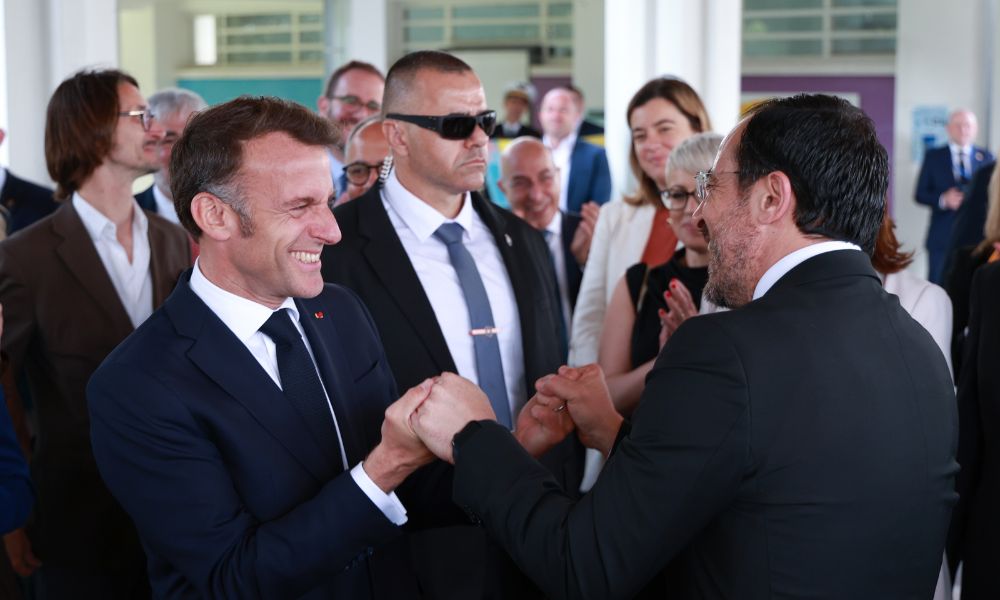
Cyprus has since confirmed it will sign a Status of Forces Agreement with France in June, which President Nikos Christodoulides said “will provide for the presence of French forces on Cypriot territory strictly for humanitarian purposes”. He added: “France is the EU member state with which we have the strongest cooperation at all levels.”
Ankara reacted sharply. Turkish defence officials said such initiatives risk “disrupting the delicate balance” in Cyprus.
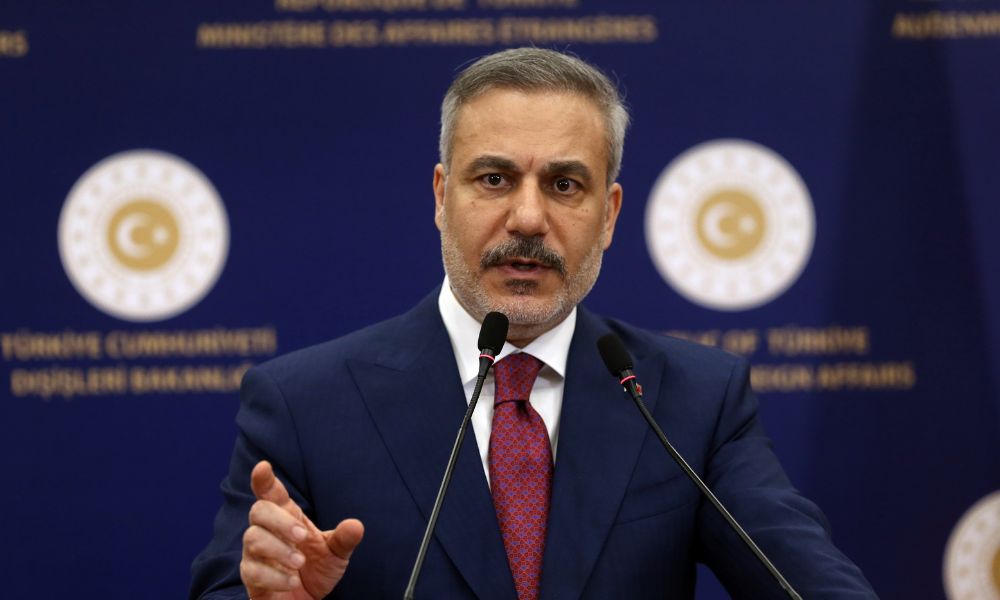
On April 13, Turkish Foreign Minister Hakan Fidan accused France, Greece and Cyprus of trying to “encircle Turkey”, warning: “The collaborations they carry out bring more problems, they bring war.”
A week later, Fidan went a step further, accusing Israel and Cyprus of forming “a military alliance against Muslim countries”.
Turkish Cypriot leaders also voiced opposition. Tufan Erhürman said Greek Cypriots and the EU were acting as if Turkish Cypriots do not exist, asking: “Does anyone truly believe that a solution on this island is possible while ignoring Turkish Cypriots?” Ruling coalition leader Ünal Üstel called the possible deployment of French forces “an extremely dangerous, provocative and unacceptable step”.
Cyprus exposed
International relations expert James Ker‑Lindsay argues that Cyprus’ strategic trajectory, while in the right direction, faces challenges.
“Cyprus made its choice and cut its ties with Russia. The next logical step would have been to join NATO. But they can’t get in, and that’s a big problem,” he said.
Cyprus, he added, understands the direction in which global politics are moving and believes it can play a meaningful role as an EU member, particularly in outreach and humanitarian operations. But that role carries risk.
“If that makes the country a target, it wants to be sure its EU partners will back it up.”
Outside NATO, Ker‑Lindsay said, the only viable alternative is to strengthen the EU’s own security framework. That, however, raises difficult questions about scope and participation.
“The EU defence mechanism could become a lot more important because of what we’re seeing with Trump and NATO. But it can’t just be about the EU. How do you involve the UK, Iceland, Norway, Canada, Turkey?”
Turkey’s posture, he noted, complicates matters further, especially on Ukraine. “If Ankara is feeling nervous, it’s because it’s making others nervous.”
Turkey-France tensions
Mete Hatay, a researcher for PRIO Cyprus Centre, finds the escalating rhetoric between Ankara and Paris particularly concerning. While Turkey maintains open channels with Washington, he said, communication with France is far more limited. “It is a bit worrying.”
Alignment risks
Another analyst, speaking on condition of anonymity, said Cyprus’ westward reorientation was strategically sound, but warned against over‑reliance on any single partner.
“Cyprus wants to be at the heart of the European debate on security in the Middle East, saying it can be an important part of that. But it needs to be a little cautious about aligning itself too closely with France.”
France’s relationship with Turkey, the analyst noted, has long been complex. When Cyprus joined the EU in 2004, Nicosia believed Paris would back efforts to extract concessions from Ankara in exchange for opening accession talks. That expectation proved misplaced.
More broadly, the analyst said Turkey’s irritation with growing Cyprus-France ties should not be overstated. No one in Ankara believes Cyprus intends to retake the north. The greater concern lies elsewhere.
“The bigger issue in many ways is the Israel‑Cyprus‑Greece nexus, which Turkey views with concern.”
Turkey’s threat perception
That assessment is shared by Nathalie Tocci, director of the Istituto Affari Internazionali (IAI) and a former adviser to EU foreign policy chiefs.
While Ankara would have been irritated by Von der Leyen’s remarks about Turkish influence, Tocci said Turkey’s genuine threat perception is focused elsewhere.
“Turkey is single handedly focused on the threat from Israel.”
“It is clear that Israel is increasingly becoming a revisionist player and intent on smashing states left right and centre. Turkey sees the threat from Israel, not Europe.”
Europe, she added, is not viewed as a strategic danger.
“It doesn’t see the EU as a threat because it actually feels it has increasingly gained the upper hand in its relationship with Europe, to the extent that Turkey is seen as an increasingly indispensable player in a reconfigured European security space.”
Turkey’s leverage, Tocci argued, has grown since Russia’s invasion of Ukraine, driven by its defence industry, drone cooperation with Kyiv, and ability to maintain channels with both Moscow and Washington.
“The Middle East is important to Europe but not as existential an issue as Ukraine.”
Ankara feels “Europe needs Turkey,” a view reinforced when Europeans keep mum about the imprisonment of Istanbul Mayor Ekrem İmamoğlu. Turkey sees Europeans as “weak, racist, divided,” she added.
As a result, Tocci said, Ankara feels strong rather than threatened. “They can get annoyed but not threatened.”
The danger of vacuum
Tocci also warned that the prolonged absence of Cyprus peace talks carries risks.
The current vacuum, she said, “definitely creates a risk”. In a period marked by “the genocide in Gaza, the wiping out of Lebanon, the fifth year of war in Ukraine,” smaller issues can escalate without drawing international attention.
In a scenario where NATO credibility erodes and Europe drifts towards re‑militarisation, this is where smaller things can happen that do not get the attention of bigger powers.
On Cyprus’ push to advance Article 42.7, Tocci said the effort was justified, but not primarily because of the need to protect neutral states.
“What happens if a NATO member is attacked and Article 5 doesn’t function. This is what makes 42.7 even more relevant.”
“This is the big question – nobody says it openly, everyone knows – the NATO mutual defence clause is not there.”
“No one actually believes Trump would militarily intervene to protect Estonia if something happens, for example.”
The security dilemma
Zenonas Tziarras of the University of Cyprus said France’s regional role is not new but part of a longer trajectory.
“This is an extension of what’s been happening in the Eastern Mediterranean the last 10 years. It’s not a very radical change.”
France, he said, is seeking to reassert itself as a central European power in the process of pursuing EU strategic autonomy, while Cyprus and Greece have pursued deterrence in response to perceived Turkish threats.
Turkey, for its part, sees Israel as the primary concern, and any alignment that includes Israel as inherently problematic.
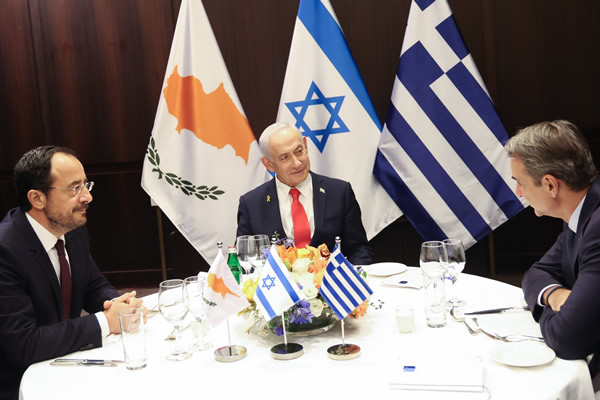
Cyprus may see its ties with Israel as a deterrent, Tziarras warned, without fully accounting for longer‑term consequences.
“We may end up a spare part of a geopolitical conflict in the region without wanting to.”
He described the situation as a classic security dilemma.
“If you don’t break the security dilemma – usually through communication and diplomacy – it can lead to this tension.”
Without negotiations, he said, military build‑ups will increase tensions rather than reduce them. Yet Cyprus also cannot afford inaction. “And this is the conundrum Nicosia finds itself in.”
Turkey’s response
Former Turkish Cypriot negotiator Kudret Özersay raised three concerns.
First, he questioned whether President Nikos Christodoulides’ focus on security alliances is driven partly by domestic politics, either ahead of parliamentary elections or the 2028 presidential race.
“It’s almost impossible to be the ally of the US, Israel, France at the same time.”
“I don’t think a country this size and capacity will be able to deliver all these things.”
Second, he said the perception of threat in Ankara is open to interpretation, but the outcome is clear.
“One thing is sure; this will definitely create a basis, reason or excuse for Turkey to strengthen its position in Cyprus.”
Turkey has always viewed Cyprus through a security lens. As the Republic of Cyprus adopts similar logic, Ankara gains justification to expand its military footprint.
“This has already made it possible for Turkey to build an additional radar system here. It may continue with an air defence system or something more.”
Finally, Özersay questioned whether France would ultimately act if Cyprus were threatened.
“Take what they have done for Ukraine, or what they said about Lebanon and what they have done when Israel attacks Lebanon.”
Cyprus may feel more secure, he warned, but the reality could be the opposite.
“On the contrary, it will be a target for more conflict. Plus, it will enable Turkey to take further steps, which may include a military naval base in north Cyprus.”