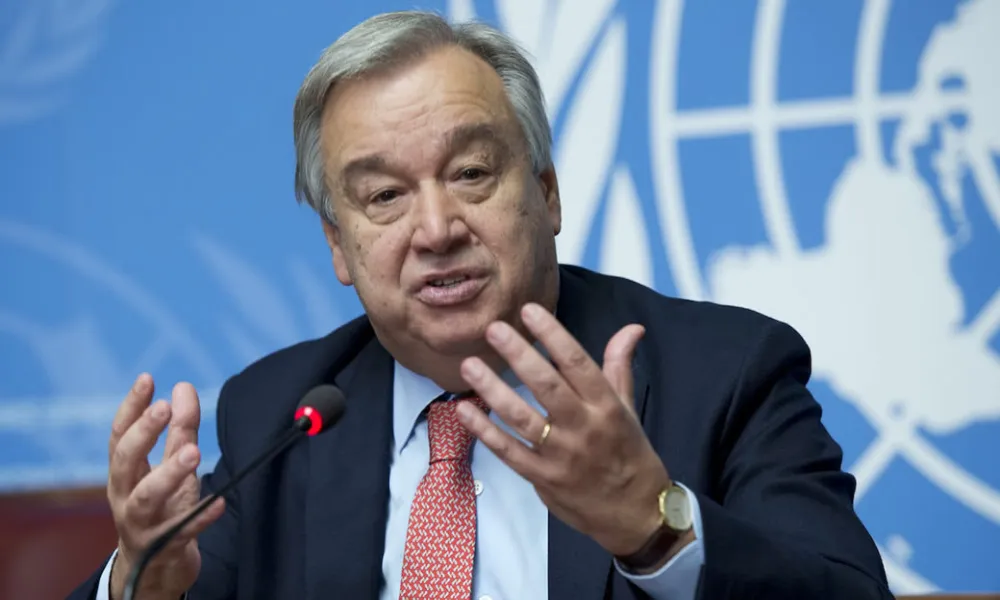
As United Nations Secretary-General António Guterres moves toward what could be his final meaningful initiative on Cyprus before his term ends in December 2026, the outline of a new diplomatic effort is becoming clearer. This time, however, the question is not simply whether talks can resume, but under what precise conditions they can even start.
Recent diplomatic exchanges have sharpened positions rather than softened them. During meetings on March 12 with President Recep Tayyip Erdoğan and Foreign Minister Hakan Fidan, followed by Fidan’s March 30 phone call, Ankara conveyed its stance to the UN chief in unusually direct terms. The same position was reiterated at the Antalya Diplomacy Forum to UN Under-Secretary-General for Political and Peacebuilding Affairs Rosemary A. DiCarlo by both Turkish officials and Turkish Cypriot leader Tufan Erhürman.
That position rests on four clear and non-negotiable principles. As President Erdoğan has publicly emphasized, Türkiye believes the time for a settlement has come. However, the United Nations must first establish whether the Greek Cypriot side has genuine political will for a solution. Any process must safeguard the inherent equality, rights and interests of the Turkish Cypriot people. And most importantly, any negotiation must follow a clearly defined framework, not drift into another open-ended process with no timeline or accountability.
A “last push” shaped by deadlines
For Guterres the Cyprus file has gained urgency not because conditions have improved, but because time is running out. With nearly a dozen unresolved dossiers still on his desk, Cyprus remains both symbolically and structurally unfinished. Diplomatic sources say Guterres is preparing to call, “immediately after” the end of June, for a five-party meeting bringing together the two sides on the island and the three guarantor powers. The timing is tied to the alignment of two key factors: the conclusion of the Greek Cypriot side’s EU Council presidency and the completion of the May parliamentary elections, effectively closing the current domestic political cycle in the south.This sequencing is not incidental. It reflects a calculation that political bandwidth in Cyprus will expand after June, allowing space for a renewed multilateral format. A five-party meeting involving the two sides and the three guarantor powers is expected to be convened under UN auspices.
Yet, significantly, this is not expected to be the unveiling of a new comprehensive plan. As Erhürman has underlined, what is being prepared is “not a plan, but an initiative” — a procedural attempt to revive engagement rather than impose a solution.
The Erhürman doctrine: No more open-ended talks
At the core of the emerging dynamic lies what has increasingly become known as the Erhürman methodology. It is less a proposal than a safeguard mechanism against repetition of past failures.
This framework rests on four core elements: prior acceptance of political equality; a time-bound negotiation process; preservation of previously agreed convergences; and a safeguard ensuring that, in the event of failure, Turkish Cypriots are not pushed back into isolation, a provision often described as a “penalty clause.”
For Ankara, this approach is not tactical but structural. The memory of the Annan Plan Referendum 2004 and the collapse of the Crans-Montana Talks 2017 has hardened its position. In both cases, Turkish Cypriot consent was followed by Greek Cypriot rejection or withdrawal, reinforcing a perception that the process itself can be instrumentalized to maintain the status quo.
This explains why Turkish officials now openly state that they will not enter a process “destined to fail.” The demand for a timeframe and a form of accountability mechanism is, in this sense, a direct response to accumulated diplomatic fatigue.
CBMs: Movement without momentum
On the ground, technical engagement continues, but without translating into political momentum. Negotiators have made incremental progress on confidence-building measures, including improvements at crossing points such as Metehan (Ayios Dhometios) and administrative facilitation at Zodhia.
There has also been movement on sectoral cooperation, including the long-discussed agreement on halloumi. Yet these developments remain limited in scope. Even after extensive discussions, no breakthrough appears imminent on politically sensitive issues such as the opening of new crossing points.
The contrast is striking: While technical dialogue advances cautiously, the political process remains stalled. This divergence has led to a gradual erosion of expectations that CBMs alone could generate sufficient trust to restart negotiations. As a result, diplomatic focus has shifted back to the UN Secretary-General as the only actor capable of injecting momentum.
A divided reading of the same moment
The anticipated July initiative is being interpreted differently by the two sides.
Greek Cypriot sources suggest that Guterres is exploring ways to repackage existing negotiation material without triggering rejection from Türkiye. This includes potential use of European Union incentives in areas such as customs union modernization, mobility arrangements, and broader economic engagement.
However, Ankara’s reading is more cautious. From its perspective, incentives cannot substitute for structural guarantees. Without a clear shift in the Greek Cypriot leadership’s approach, particularly on sovereign equality and effective decision-making participation, any new process risks replicating previous cycles.
The leadership of Nikos Christodoulides is therefore seen as a critical variable. Diplomatic assessments increasingly frame the success or failure of a new initiative less in terms of UN design and more in terms of political readiness in the south. In this context, not only the Turkish side, but also some diplomats who have engaged directly with him, portray Christodoulides as a difficult interlocutor, pointing to what they describe as a pattern of rigidity, persistent grievance-driven rhetoric, and a style they view as insufficiently geared toward compromise, factors they believe complicate the prospects for meaningful progress.
The weight of history and the inertia of the present
The anniversary of the opening of crossing points on April 23, 2003 passed with little ceremony, yet it triggered renewed reflection, particularly in Greek Cypriot commentary.
Analyses in the Greek Cypriot press have pointed to a recurring pattern: moments of opportunity followed by political hesitation. From 2004 to 2017, the inability to convert diplomatic openings into durable agreements has reinforced a status quo that is no longer neutral.
What emerges is a paradox. While both communities express, in different ways, a desire for resolution, the political systems on both sides operate within constraints that discourage risk-taking.
In the north, trust remains the central deficit. In the south, the cost of compromise continues to outweigh the perceived benefits of settlement.
A regional equation that no longer allows isolation
Unlike earlier negotiation cycles, the current Cyprus debate is unfolding within a rapidly shifting regional environment.
The war dynamics involving Iran, the instability in Lebanon, and the broader transformation toward a more transactional international system have altered the strategic context. Energy routes, security alignments, and military deployments in the Eastern Mediterranean have increasingly intersected with the Cyprus question.
This means that Cyprus is no longer a self-contained dispute. It is part of a wider geopolitical matrix in which external actors, from the European Union to regional powers, have growing stakes.
For Türkiye, this adds both urgency and complexity. The island is not only a political issue but also a component of a broader security architecture.
Between initiative and impasse
As July approaches, expectations remain deliberately restrained.
Guterres is expected to call the parties to the table. Türkiye and the Turkish Cypriot leadership have already signaled that they will accept such an invitation. Yet acceptance of a meeting does not imply acceptance of a process.
The central question is no longer whether talks will resume, but whether they can be structured in a way that avoids repeating the cycle of engagement without outcome.
If the Greek Cypriot side demonstrates flexibility, particularly on issues Ankara considers foundational, the July initiative could mark the beginning of a new phase. If not, it risks becoming another procedural episode in a long history of inconclusive diplomacy.
In that sense, the coming months may not determine the solution to the Cyprus problem. But they will determine whether the conditions for a solution still exist.