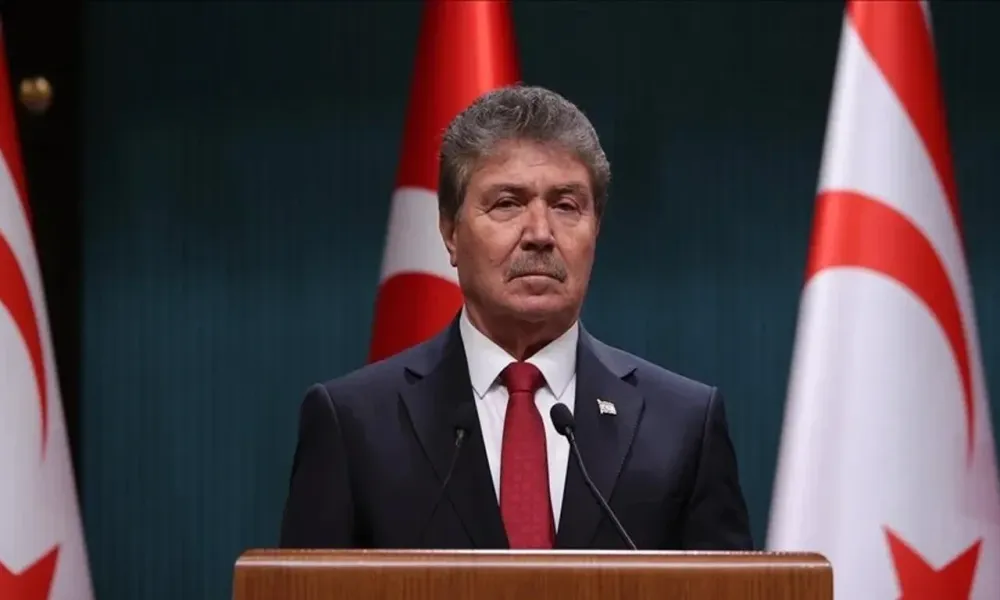
The head of the Turkish Cypriot ruling coalition in the north interpreted last week’s informal EU leaders’ summit as an attempt to establish a political bloc against Turkey and the Turkish Cypriots.
Turkish Cypriot ‘prime minister’ Ünal Üstel was quoted by Daily Sabah saying on Sunday that Cyprus President Nikos Christodoulides’ effort to invoke Article 42.7 of the Treaty on European Union (TEU), the EU’s mututal defence clause, was “clear in its intention”.
He accused the Cyprus Republic of attempting “to involve Europe in their maximalist policies in the Eastern Mediterranean, to institutionalise their search for military protection and establish a political bloc against the Turkish Republic of Northern Cyprus and Türkiye”.
Üstel added: "The Greek Cypriot administration insists on portraying Türkiye and the TRNC as a threat. But the truth is obvious. It is not Türkiye or Turkish Cypriots raising tensions in the region. On the contrary, it is the Greek Cypriot administration that escalated armament in recent years, signed military agreements with various countries and made the island a hub for foreign military entities.”
He further accused the Cyprus Republic of putting the island at the heart of wars and using a threatening rhetoric against both the Turkish Cypriots and Turkey.
The head of the ruling coalition said despite the aggressive stance of the Greek Cypriots over the decades, “the Turkish Cypriot people will never give up their rights, sovereign equality, or security.”
He called on the EU to grasp these realities. In contrast to the support voiced by Turkish Cypriot leader Tufan Erhürman for a federal solution, Üstel noted that the ruling coaltion “will resolutely continue to defend our vision of a two-state solution based on sovereign equality and equal international status, shaped with the strong support of our motherland Türkiye”.
Drone prompts clause review
Christodoulides used last week’s two-day informal summit in Ayia Napa and Nicosia to raise the need to formalise procedures to be followed when an EU member state invokes the article.
According to Article 42.7 of the TEU, as amended by the Lisbon Treaty: “If a Member State is the victim of armed aggression on its territory, the other Member States shall have towards it an obligation of aid and assistance by all the means in their power, in accordance with Article 51 of the United Nations Charter.”
Although a legal obligation, the article does not prescribe automatic military action. It adds two important qualifications that allow member states to decide what form of suport to offer, in line with their own policies, laws and capabilities. It also makes clear that it does not replace NATO, which remains the main collective defence framework for NATO members.
The article has only ever been formally invoked once by France in 2015, after Paris came under terrorist attack.
Following a drone attack on the British Bases at Akrotiri on March 2, Cyprus did not invoke Article 42.7, likely because it did not wish to equate an attack on the British Bases with an attack on the Cyprus Republic – particularly given the country’s standing as a tourist destination. However, it did appeal to EU partners for support, and five member states – Greece, France, Spain, Italy and the Netherlands – sent naval, air and other military assets to Cyprus, providing a protective umbrella against potential drone and missile strikes.
The rapid response prompted Christodoulides to try and focus minds on how to put flesh on the bones of the EU mutual defence clause, providing more predictability on what a member state can expect if it invokes the mutual defence clause.