Turkish Cypriot "Prime Minister" Ünal Üstel’s visit to Baku this week was designed to project diplomatic visibility and reinforce the Northern Cyprus’ observer role within the Organization of Turkic States. Meeting counterparts such as Ali Asadov, Üstel leaned into a familiar narrative of sovereign equality and international engagement.
But the optics abroad contrast sharply with the political reality at home. In nothern Nicosia, a domestic crisis is unfolding that has now moved beyond a fiscal dispute into a multi-layered institutional confrontation, where strategy, timing and political miscalculation have proven as decisive as law itself.
Decree politics: Bypassing parliament, exploiting timing
Just before Üstel’s departure, the three-party coalition government invoked Article 112 of the constitution to issue a decree with the force of law, effectively freezing cost-of-living (COL) adjustments for public sector workers. These adjustments, tied to inflation, are a core mechanism for maintaining purchasing power in an economy shaped by chronic price instability.
The move followed the "government"’s failure to secure parliamentary approval for similar legislation. Formally, the decree mechanism remains within constitutional bounds. Politically, however, its use has triggered a far sharper reaction.
There was no procedural barrier preventing the "Assembly" from convening. The issue had merely been postponed. Negotiations with trade unions were still ongoing. Yet the government chose to act in the evening, after parliamentary activity had been suspended and while negotiations were still in flux. The objective was clear: ensure the measure took effect before the April 1 payroll cycle.
What might appear as a technical fiscal intervention was, in practice, a carefully timed political maneuver. The urgency was not institutional necessity but political calculation.
A night of miscalculation: Unions and opposition outmaneuvered
The turning point came not only from the "government"’s action, but from what its opponents failed to anticipate.
Union leaders, who had been warning that “protests would continue until the government falls,” unexpectedly began suspending strike actions. The "Assembly" had been adjourned for a week, and a sense of tactical pause set in. The assumption was that the issue had effectively slipped into April, buying time for negotiation.
That assumption proved costly. According to accounts from within the ruling National Unity Party, the government had already settled on a simple strategy: secure the three-month CoLA adjustment through a decree, gain time, and then convert it into law once parliament reconvenes.
As one senior coalition figure reportedly put it, unions were preparing to escalate through strikes, the opposition was ready to dominate parliamentary debate for hours or days, “and we were expected not to play politics?”
The same source pointed to the critical timing gap. By late evening, union leadership had dispersed. By early morning, opposition lawmakers, exhausted after prolonged speeches, had requested a break. That break crossed into March 31. In that window, the government acted.
The implication is stark. Both unions and the opposition did not simply pause. They misread the strategic environment. In what has increasingly been described as a “political chess game,” they failed to anticipate that the executive still held the decree option.
From fiscal measure to political confrontation
The government’s narrative rests on fiscal necessity. Finance authorities have, for the first time, quantified the expected impact, arguing that the measure could generate savings of up to 3 billion TL by year-end, potentially easing price pressures in the market.
Yet this claim is contested. Former finance officials and bureaucrats argue the opposite: that the decision could further destabilize public finances and deepen structural imbalances rather than alleviate them.
For public sector workers, the issue is more immediate. CoLA adjustments are not perceived as discretionary benefits but as essential protections against inflation. Freezing them is therefore understood as a direct reduction in real income.
This perception has transformed the issue from a budgetary adjustment into a question of economic fairness and political trust.
Erhürman prepares legal escalation amid public clashes
Turkish Cypriot leader Tufan Erhürman has emerged as the central institutional counterweight. A constitutional law scholar, Erhürman has framed the decree as a misuse of executive authority and a direct encroachment on parliamentary prerogatives.
The confrontation has already moved beyond formal channels. Exchanges between the presidency and the government have become increasingly sharp, with tensions spilling into social media and the press, exposing a rare and visible fracture within the state structure.
The next step is expected to be legal. The presidency is preparing to challenge the decree before the Council of State, seeking its annulment on the grounds that it fails to meet the constitutional criteria of urgency and necessity.
In parallel, unions have initiated their own legal process, applying for an injunction against the decree. The case is scheduled to be heard on April 6, a date that could become a critical inflection point. Whether the court will issue a rapid ruling, or whether the temporary nature of the decree will complicate the issuance of an injunction, remains uncertain.
The possibility of a further referral to the High Court also remains on the table, potentially expanding the legal scope of the dispute.
Street pressure and political theater
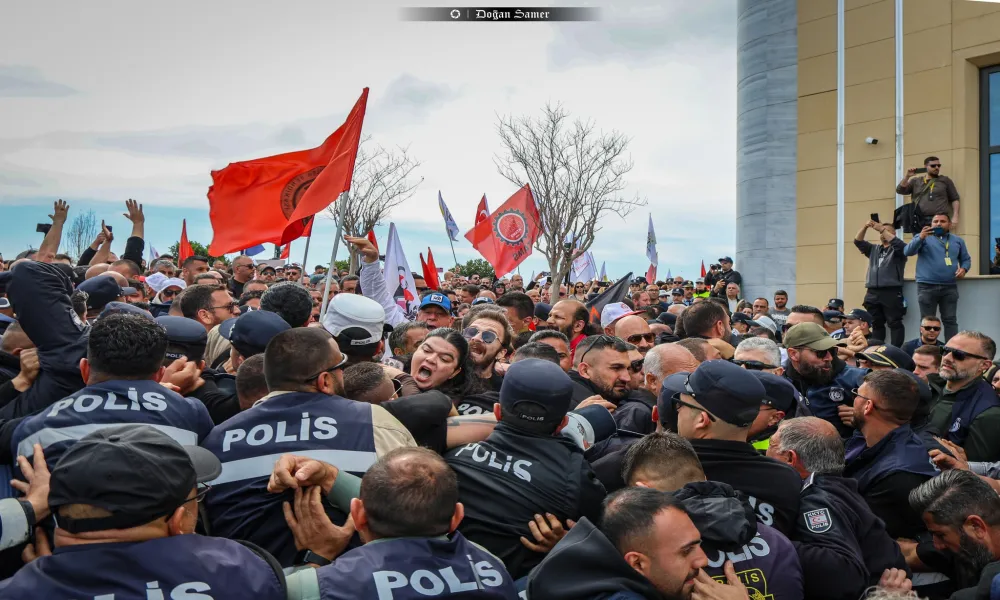
Legal escalation is unfolding alongside mounting pressure on the streets.
A general strike decision has now been taken across the Northern Cyprus. Yet even here, uncertainty persists. Will protests continue until the government resigns, or will they subside if the wage decision is reversed? The answer is not yet clear, and unions themselves face a test of coherence and strategy.
The political symbolism has intensified. When Üstel returned to the island on Saturday afternoon, he was met not only by protesting unions but also by a mobilized crowd of party supporters organized by the ruling party. The result was a dual reception, protest and counter-mobilization, reflecting a society increasingly polarized along political lines.
Institutional fault lines widen
Parliament remains temporarily suspended, but when it reconvenes, the confrontation will resume from where it left off. The government is expected to move swiftly to transform the decree into legislation, relying on its parliamentary majority.
This determination has been signaled clearly. The decree itself is the strongest indicator of intent.
What distinguishes the current crisis is not a single decision, but the convergence of multiple fault lines. Executive authority has expanded into legislative space. The presidency is preparing judicial intervention. Trade unions are mobilizing both legally and politically. The opposition, having misjudged the timing once, is now recalibrating.
Each of these dynamics alone would be manageable. Together, they point to a deeper structural tension within the system.
At its core lies a question that now goes beyond Northern Cyprus:
Can executive power, under the pressure of economic urgency, redefine the limits of constitutional governance, or will institutional checks reassert themselves before that boundary is permanently redrawn?