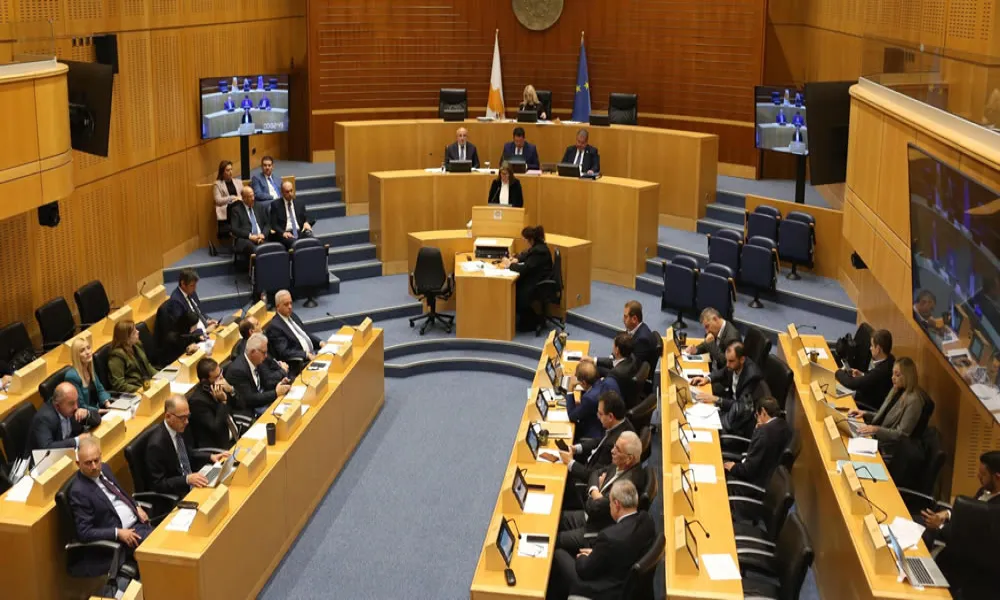

The House Rules Committee has decided to forward a legislative proposal introducing a series of changes to the operation of Parliament. The proposal aims to reform procedures for electing the Speaker, regulating committee meetings, introducing live broadcasts and strengthening parliamentary oversight of ministers.
The changes are intended to enter into force with the new composition of Parliament following the elections scheduled for May.
Legislative proposal to be submitted to plenary
The committee, which met under the chairmanship of House Speaker Annita Demetriou, agreed to submit the full package of proposed changes to the plenary for approval in the form of a bill.
The proposal is expected to be brought before the plenary session of Parliament on 2 April 2026.
Changes to the election of the Speaker
The current procedure for electing the Speaker of the House involves up to four stages, a system that has been criticised as complex and open to temporary political alliances.
Under the proposed reform, the Speaker would be elected by an absolute majority of all members of Parliament. If no candidate achieves that threshold, a second round would be held and the Speaker would be elected by simple majority.
Following the swearing-in ceremony of members, nominations for Speaker would be submitted by one MP on behalf of another. A candidate securing at least 29 of the 56 votes would be elected.
If no candidate obtains an absolute majority in the first round, a second vote would take place between the two leading candidates. The candidate receiving the highest number of votes would be elected.
In the event of a tie, a repeat vote would be held. If the tie persists, the Speaker would be determined by a public draw.
Live broadcasts of committee meetings
The proposal also introduces live broadcasts of parliamentary committee meetings in certain cases.
Sessions discussing self-initiated topics or examining draft laws at the initial stage would be broadcast live by Parliament. The decision to broadcast, as well as the procedure and timing, would require the approval of the Speaker following the consent of the majority of committee members.
Acting Speaker during presidential absence
Currently, when the Speaker of the House assumes the duties of President of the Republic during the President’s absence abroad, the role of Speaker is temporarily performed by the oldest MP.
The proposed change would allow Parliament to appoint any member to perform the duties of Speaker during that period.
Representation in leaders’ meetings
Every Thursday before the plenary session, party leaders or parliamentary representatives meet under the chairmanship of the Speaker to discuss parliamentary matters and the plenary agenda.
The proposed amendment provides that large parties forming parliamentary groups will be represented by two members, while smaller parties will have one representative.
Time limits for committee meetings
The proposal introduces a maximum duration for parliamentary committee meetings of two and a half hours.
Longer meetings would only be permitted in exceptional urgent cases and with the prior approval of the Speaker of the House. The request would need to be submitted before the committee agenda is circulated.
Currently, no time limit exists, and some meetings extend for several hours, often requiring senior public officials and ministry directors to remain present throughout the proceedings.
The new provision aims to improve time management, focus discussions on substantive matters and reduce unnecessary administrative costs.
Publication of unanswered parliamentary questions
Parliament will also publish weekly on its website a list of parliamentary questions that have not received a response from the relevant ministries within the required timeframe.
Under parliamentary rules, ministers must respond to MPs’ questions within 30 days of receiving them.
This measure aims to enhance transparency and accountability regarding the response of ministers to parliamentary oversight.
Service schemes for parliamentary posts
The responsibilities and duties of each permanent, non-rotational position in Parliament will be defined through formal service schemes.
These schemes will be prepared by the Speaker of the House based on the principles of transparency, impartiality and objectivity, following consultation with party leaders and parliamentary representatives.
Until the new schemes are adopted, the existing arrangements will remain in force.