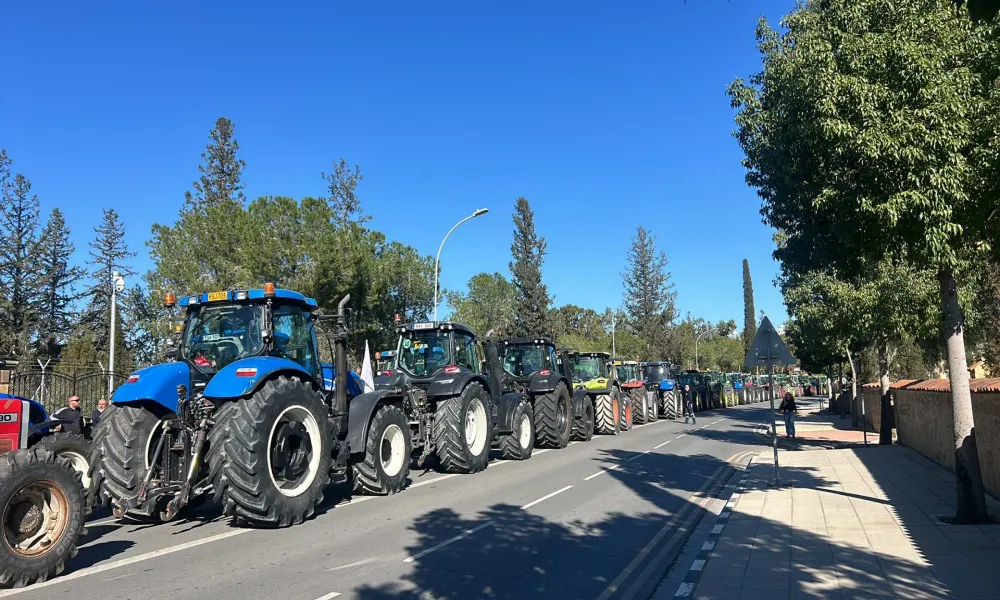
Farmers from across Cyprus arrived at the Presidential Palace in their tractors on Tuesday morning, taking part in a pan-European mobilisation against the European Union’s agricultural policy. They are expected to submit a memorandum to the President of the Republic, Nikos Christodoulides, and then proceed to the House of Europe.
Alongside broader European concerns, Cypriot farmers are also raising local issues, including delays in the payment of area-based subsidies. Protesters initially gathered at the parking areas of the GSP Stadium and the JUMBO store before moving towards central Nicosia.
According to a previous report by Politis, the President of the Pancyprian Cereal Growers’ Organisation, Kyriakos Kailas, said the mobilisation in Cyprus is mainly driven by the severe impact of the decision to reduce the Common Agricultural Policy budget by €86.5 billion. Such a reduction, he said, would lead to the collapse of the primary production sector in most EU member states.
“In our case, where we already have the lowest average level of production, it would be even worse. It would be the final blow to primary production in Cyprus,” he stressed.
As Cyprus is an island and farmers cannot travel to Brussels, they are demonstrating locally, as are other countries far from the EU capital. From 10:15 am, farmers have taken to the streets of Nicosia to deliver memoranda to the Presidential Palace and later to the House of Europe. In a statement, organisers said the protest is driven by unprecedented financial pressure on the primary sector, the impact of imports, plans to change the architecture of the Common Agricultural Policy after 2027 with a reduced budget, bureaucratic procedures, and the effects of the climate crisis, which is already driving costs to unsustainable levels.
Cyprus-specific issues
At the same time, today’s protest has been used by representatives of farming organisations to highlight Cyprus-specific agricultural problems. These include delays by CAPO (KOAP) in paying area-based subsidies and the ban preventing refugee farmers from subleasing Turkish Cypriot agricultural land to professional farmers.
“We will go out and we will stay until the problems are resolved,” Mr Kailas warned last Friday in an interview with Politis 107.6, referring to the possibility of prolonged delays in subsidy payments. He said the government cites the late submission of beneficiary lists from the Department of Lands and Surveys to CAPO as the reason for the delays.
Increased traffic near the Presidential Palace and the House of Europe
Traffic congestion has increased due to the protest by agricultural organisations heading towards the Presidential Palace and the House of Europe.
Heavier traffic is observed in the city centre, while significant movement of agricultural vehicles is also recorded on intercity roads leading to Nicosia.
Police are present at all critical points to direct traffic and ensure the smooth conduct of the march. Participants and motorists are urged to follow police instructions.
Roads currently affected
Farmers are using the following routes to reach their destinations:
Towards the Presidential Palace:
Joseph Hadjiiosif Avenue, Athalassas Avenue, Presidential Palace Avenue
Towards the House of Europe:
Demostheni Severi Avenue, Lord Byron Avenue
General:
Roads in central Nicosia, as well as intercity routes with increased traffic from agricultural vehicles heading towards the capital.