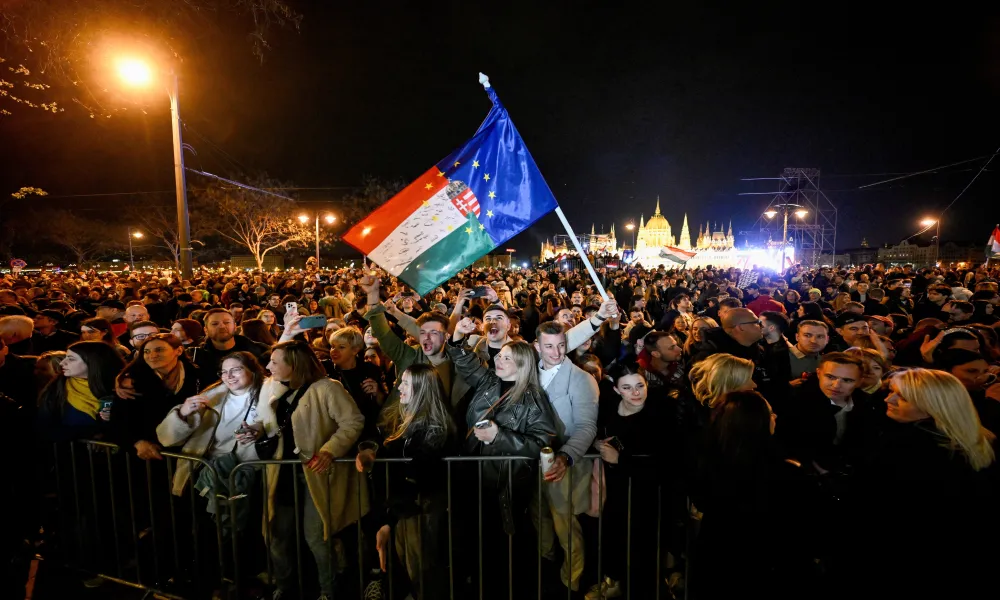

Hungary’s April 12 election has triggered an inevitable question in Türkiye: Can a system that has reshaped institutions, media and political language over years be reversed at the ballot box? The Hungarian case suggests that it can, but only under specific conditions that go beyond simple opposition unity or ideological confrontation. Péter Magyar’s rise and the decisive defeat of Viktor Orbán did not come from a conventional coalition model. It emerged from a recalibration of political language, leadership style and voter psychology.
At first glance, parallels exist. In Türkiye’s March 2024 local elections, the Republican People’s Party (CHP) emerged as the first party nationwide for the first time in decades, capturing major metropolitan municipalities and consolidating urban political ground. Yet this electoral shift has unfolded alongside a dramatically tightening political environment. Nearly three dozen opposition mayors are currently in prison, including the mayor of Istanbul, a metropolis whose scale rivals that of many European countries. Scores of municipalities are now administered by trustees or acting mayors, raising fundamental questions about the durability of electoral gains under legal and administrative pressure.
The Hungarian example therefore offers both inspiration and caution.
Reclaiming the narrative without alienating the base
What worked in Hungary was not simply opposition unity but narrative disruption. Magyar did not confront Orbán from the ideological margins. He entered the political field from within its cultural and ideological boundaries. Conservative in tone, nationally rooted yet reformist in message, he prevented Orbán from monopolizing patriotism and identity.
This is a critical lesson for Türkiye. Opposition success requires more than criticism of authoritarian tendencies. It requires a language that reassures rather than alienates. Hungarian voters were not asked to abandon their national identity. They were asked whether that identity had been exploited by a system increasingly associated with corruption and stagnation.
Türkiye’s opposition still struggles with this balance. It often oscillates between technocratic critique and moral indignation, neither of which fully penetrates conservative voter bases. Hungary demonstrates that change becomes possible when voters feel they are not betraying themselves by supporting it.
From institutional critique to everyday experience
Another decisive factor in Hungary was the translation of abstract governance failures into daily life realities. Issues such as rule of law or media freedom, while important, rarely mobilize voters on their own. They become politically potent when linked to economic hardship, inequality and declining public services.
Hungary’s opposition succeeded in connecting corruption to tangible consequences such as blocked EU funds, weakened economic performance and declining living standards. The message was simple: Governance failure has a price, and society is paying it.
In Türkiye, a similar opportunity exists. Inflation, housing affordability, youth unemployment and perceived erosion of meritocracy have created a widespread sense of economic strain. However, the opposition has not always succeeded in framing these issues as systemic outcomes rather than isolated policy failures. Hungary shows that when governance critique becomes a story about everyday life, it gains political traction.
Leadership, momentum and the limits of coalition arithmetic
Magyar’s success also underscores the importance of leadership as a unifying force. He did not represent a fragmented opposition front but a political moment embodied in a single, dynamic figure. This contrasts sharply with Türkiye’s experience in the 2023 presidential election, where broad alliances failed to generate sufficient emotional momentum.
However, Türkiye’s context imposes clear limits on direct comparison. Unlike Hungary, Türkiye’s political landscape is shaped by multiple intersecting cleavages including ethnic identity, secular-conservative divides, migration pressures and regional disparities. A single figure model carries both potential and risk.
The 2024 local elections offered a partial counterexample. In cities like İstanbul and Ankara, credible candidates with strong local governance records were able to transcend traditional divides. This suggests that leadership matters, but it must be anchored in performance and institutional trust rather than personal charisma alone.
Fear, trust and the possibility of political exit
A less visible but equally critical factor in Hungary was the reduction of fear. Long-term incumbency often relies on constructing a narrative of risk around change. Orbán’s system emphasized threats ranging from external actors to internal instability.
Magyar’s strategy did not dismiss these fears outright. Instead, it repositioned them. He argued that the greater risk lay in continued stagnation and institutional decay. This reframing allowed voters to consider change without feeling exposed.
In Türkiye, this dynamic is even more pronounced. Security concerns, regional instability and historical experiences shape voter behavior deeply. For many citizens, political choice is not only about preference but about perceived risk.
An effective opposition strategy must therefore create a “safe exit” pathway for government supporters. It must signal continuity in stability while offering change in governance. Without this reassurance, dissatisfaction alone is unlikely to translate into electoral turnover.
Institutional pressure and the limits of electoral victory
Perhaps the most significant difference between Hungary and Türkiye lies in the post-election environment. Hungary’s opposition victory translated directly into parliamentary control. In Türkiye, electoral success at the local level has not necessarily ensured governance continuity.
The detention of elected mayors, the appointment of trustees and the legal pressures on opposition figures indicate a structural constraint that goes beyond voter behavior. This creates a paradox. Even when the opposition wins, it must still defend its victories institutionally.
This reality complicates any straightforward application of the Hungarian model. Electoral momentum alone may not be sufficient. It must be accompanied by legal preparedness, institutional resilience and sustained public legitimacy.
Can the Hungarian model be adapted?
The Hungarian experience does not offer a template but a framework. Its core elements include narrative control, leadership credibility, voter reassurance, economic framing and organizational discipline. These elements are transferable in principle but require significant adaptation.
Türkiye’s opposition already holds an important advantage: Demonstrated governance capacity in major municipalities. If leveraged effectively, this can serve as a proof-of-concept for national leadership. However, this advantage remains vulnerable to institutional intervention.
The path forward is therefore neither imitation nor dismissal. Hungary shows that entrenched systems can be challenged when political fatigue converges with credible alternatives. Türkiye, however, demands a broader coalition of narratives, actors and strategies capable of navigating a more complex political terrain.
The real question is not whether what worked in Hungary can work in Türkiye. It is whether Türkiye’s opposition can construct its own version of that success, one that reflects its realities rather than replicating another country’s moment.