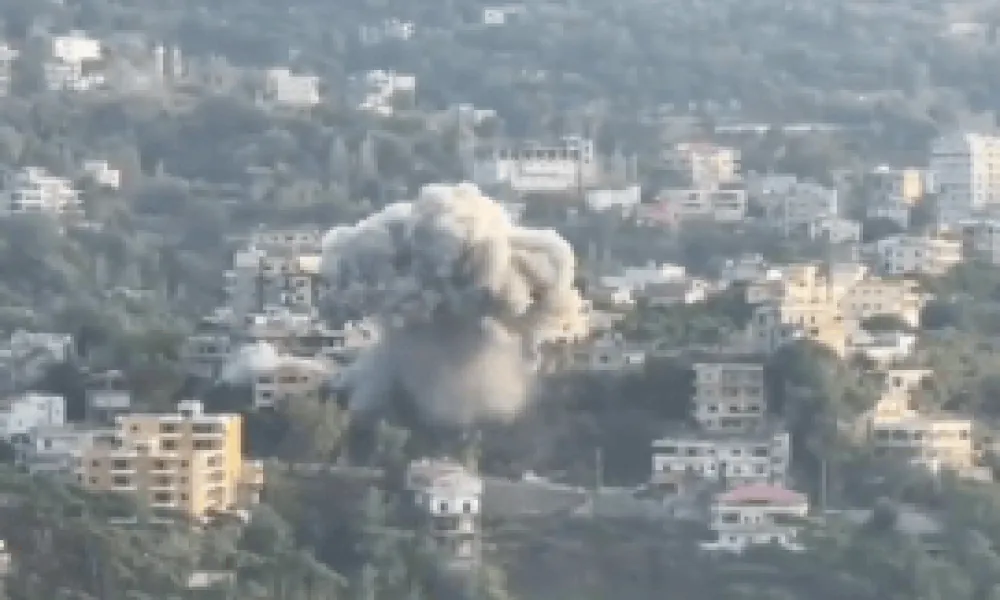

Israel’s military has carried out a series of successive air attacks on south Lebanon, causing damage to several homes, according to Lebanese state media, as Arab outlets reported mounting anger over repeated Israeli violations of a ceasefire agreed with Hezbollah a year ago through American mediation.
The Lebanese National News Agency reported late on Monday that Israeli jets targeted Mount Safi, the town of Jbaa, the Zefta Valley, and the area between Azza and Rumin Arki in “several waves”.
There was no immediate report of casualties.
The Israeli military, in a post on X, said it struck several sites linked to Hezbollah, including a special operations training compound used by its elite Radwan Force and other infrastructure installations.
The military further announced that several buildings and a rocket-launching site were also hit.
The attacks, as Al Jajeera's correspondents reported, come days after Israel and Lebanon dispatched civilian envoys to a military committee tasked with overseeing their ceasefire, a step towards a months-old demand by the United States, which has been urging the two countries to broaden their talks.
Lebanese President Joseph Aoun said on Friday that his country “has adopted the option of negotiations with Israel”, and that the talks were aimed at stopping Israel’s continued attacks on his country.
The current ceasefire, brokered by Washington in 2024, ended more than a year of clashes between Israel and the Iranian funded group.
Israel has caried intermittent attacks on Lebanese territory over the past few months, focusing strikes on southern border areas, arguing that Hezbollah was trying to regroup, while still refusing to rearm.
A United Nations report released in November said that at least 127 civilians, including children, have been killed in Lebanon since the ceasefire went into effect.
UN officials have warned that the strikes amount to “war crimes”.
Tensions spiked further last week when Israel bombed Beirut’s southern suburbs, a Hezbollah stronghold, killing the armed group's top military commander, Haytham Ali Tabtabai.
Weakened following last year’s conflict, the organisation has yet to respond.
Israel has repeatedly fired accusations at Lebanon of not doing enough to compel Hezbollah to relinquish its arsenal across the country, a claim the Lebanese government has also frequently denied.
Hezbollah has said it is unwilling to let go of its arms as long as Israel continues its strikes on Lebanese territory and its occupation of five points in the country’s south.
Lebanese Prime Minister Nawaf Salam underscored last week that Lebanon wanted to see the ceasefire monitoring mechanism play a more robust role in verifying Israel’s claims that Hezbollah is rearming, as well as the work of the Lebanese army in dismantling the armed group’s infrastructure.
Asked whether that meant Lebanon would accept US and French troops on the ground as part of a verification mechanism, Salam said, “Of course”.
Aas Al Jajeera reports, the continued Israeli strikes have raised fears in Lebanon that the Israeli military could expand its air campaign further.
SOURCES-Al Jajeera, CNA