
Analysis of EU data by the European Trade Union Institute found that the cost of renting an apartment with up to two bedrooms is, on average, €218 more per month than national minimum wages.
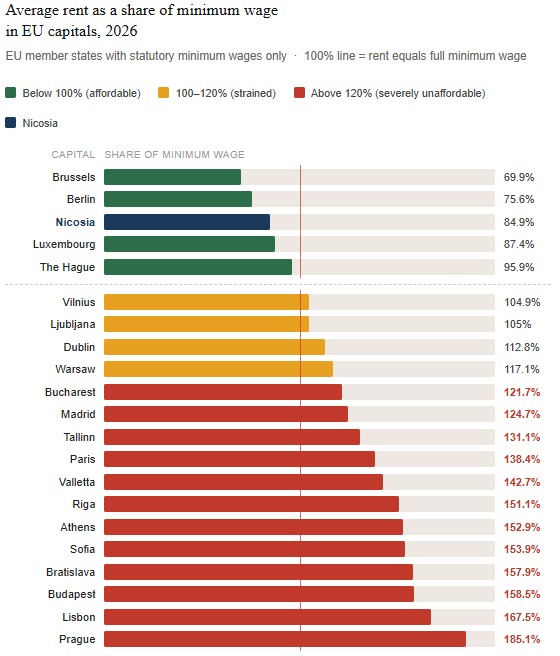
Average rent exceeds the minimum wage by more than €700 in Prague, Lisbon and Dublin, while it is over €400 higher in Athens, Bratislava, Budapest and Valletta.
In Nicosia, the difference amounts to €164, with total rent costs reaching 85% of the minimum wage.
Data basis
The findings are based on Eurostat statistics, with rental prices adjusted to 2026 levels using the Harmonised Index of Consumer Prices for January 2026. Minimum wage figures are drawn from official Eurostat data for the first half of 2026 and relate to apartments with up to two bedrooms.
Rents beyond capital cities
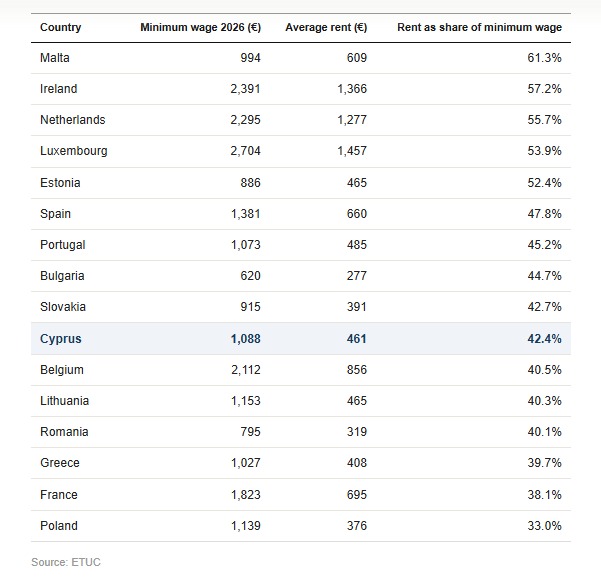
High rents are not limited to capital cities. Workers living outside capitals are also facing difficulties. When all parts of a country are considered, the average cost of renting an apartment corresponds to 42% of the minimum wage.
Low‑paid workers in five countries (Malta, Ireland, the Netherlands, Luxembourg and Estonia) spend more than half of their wages on rent for a typical one‑ to two‑bedroom apartment. In twelve other countries, workers spend one‑third or more of their wages.
In Cyprus, rental costs account for 42.4% of the minimum wage.
These figures are based on Eurostat data (EUSILC 2024 for 2023), adjusted to 2026 prices according to rental inflation, and apply to rented dwellings of up to two bedrooms. Minimum wage data are taken from Eurostat’s official figures for the first half of 2026.
Commission initiative and union proposals
The findings come ahead of the European Commission’s presentation on Wednesday of a recommendation to combat housing exclusion, as part of the Affordable Housing Action Plan.
The European Trade Union Confederation (ETUC) has put forward specific proposals to address the problem.
These include calling on all member states to fully implement the minimum wage directive, including robust action plans to substantially promote collective bargaining, ensuring more workers receive fair pay.
The ETUC also argues that governments should take housing costs into account when determining the adequacy of minimum wages.
At the same time, it proposes the introduction of rent regulations to freeze housing costs for workers, protect tenants from exploitation and shield vulnerable families from eviction.
The recommendations further include increasing public investment in social housing, including through EU investment tools and a revision of state aid rules.
“High housing costs and low wages are pushing people into poverty and the economy into downturn,” said ETUC General Secretary Esther Lynch. “When workers have money in their pockets, they spend it in the real economy. The EU must no longer allow money to be extracted through economic speculation in people’s homes,” she said.
“We urgently need to give the European economy a much‑needed boost in demand by freezing rents, raising wages and increasing investment in social housing,” she added.