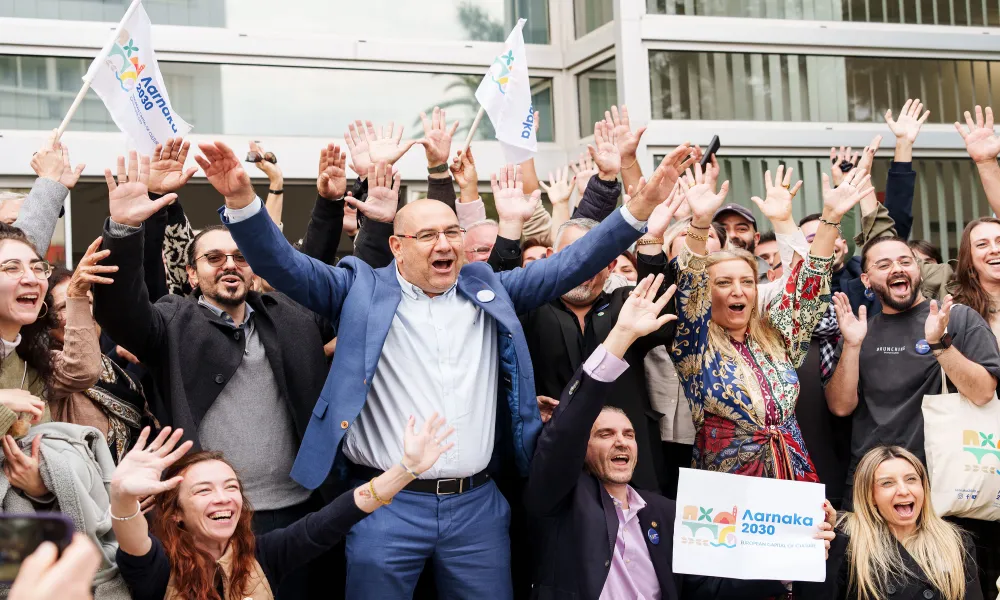
Larnaca begins work this week on the ambitious cultural transformation it outlined in its winning bid for European Capital of Culture 2030. The city now carries the responsibility of implementing the vision that convinced the panel of experts appointed by the European Commission, and must deliver on its commitments in order to secure the €1.5 million Melina Mercouri Prize.
Toni Attard, chair of the expert committee, told Politis that the panel will closely monitor the evolution of the “Larnaca 2030” organisation, issuing regular assessment reports. The rationale behind the jury’s decision will be published in January, along with recommendations already submitted to the Larnaca team.
At the heart of the bid is the concept “Common Ground”, a comprehensive cultural strategy mapped out from 2026 to 2030. The programme provides a blueprint for artistic projects, participatory processes, administrative structures, and infrastructure investments, shaping the city’s long-term cultural identity.
2026-27: Laying the Groundwork
The first phase, Seed (2026-27), focuses on establishing the organisational and participatory foundations. “Larnaca 2030” will be fully constituted with a general director and artistic director Kelly Diapouli, gradually expanding from around 23 staff in 2026 to 38 by 2030.
This phase activates the participatory structures that run through the entire programme. The Co-Creators Network, an extension of the community-based work carried out during the bid, will organise thematic working groups on equality, inclusion, youth, the music ecosystem and bicommunal collaboration. The network is supported by tools such as the “Common Ground Café”, a permanent space for dialogue and European cultural engagement, with a budget of €300,000.
The youth platform “Young Polis”, with a budget of €400,000 and participation from the Deputy Ministry of Tourism, will develop democratic engagement mechanisms for young people.
The first cultural projects also begin here:
• Synoikismos (€800,000): focusing on neighbourhoods, refugee memory and public space.
• MahalArt (€800,000): bringing artistic activity into Larnaca’s urban quarters and rural communities.
• The Earth’s Wounds (€300,000): ecological art interventions in degraded landscapes.
• The Walking Orchard (€400,000): creating new walking routes and planting networks connecting the city to its hinterland.
These early projects form the seedbed of a cultural ecosystem that will expand significantly in later phases.
2028-29: Growing and Internationalising
The Grow phase (2028–29) scales up and internationalises the programme. Projects gain European co-productions and partnerships with other Capitals of Culture.
One of the major additions is Fengaros City (€360,000), which adapts the well-known Fengaros Festival into an urban showcase combining concerts, conferences and professional exchanges. It links with the Ttavas Residency, a collaboration platform that has been running since 2023 and brings together Greek Cypriot, Turkish Cypriot and Middle Eastern musicians.
Another major cluster is the Cultural Democracy Labs (€1.35 million), including:
• Artists & Cultural Workers (€500,000): a training and mobility programme with “On the Move”.
• Small Museums (€600,000): creating a network of seven micro-museums in Larnaca and its district.
• Socially Engaged Arts (€250,000): focusing on methodologies of co-creation and community-based art.
Additional projects include:
• Herstories (€900,000): exploring women’s and queer narratives across Europe.
• Rehearsing Access (€350,000): centred on disability arts and inclusion.
• ξι-/un- (€350,000): rethinking public space through artistic and social interventions.
These projects are designed not as isolated events but as structural shifts in Larnaca’s cultural infrastructure.
2030: The Blossom Year
In 2030, the title year, the programme unfolds at full scale. A new flagship project, Insular Europe (€800,000), brings researchers and cultural organisations from Mediterranean and other European islands to Larnaca, addressing shared environmental, social and cultural challenges. By this stage, all major artistic programmes are fully operational, spread across the city and district, alongside the launch of Larnaca’s new cultural complex.
The Infrastructure of 2030
Four major infrastructure projects form the backbone of Larnaca’s cultural transformation.
At the centre is the Common Ground Cultural Complex (CGCC), budgeted at €35 million and planned for the former refinery seafront. It will host:
• the Common Ground Arts Centre (performance and visual arts, 800–1000 seat main hall, 150-seat black box, exhibition spaces and rehearsal rooms),
• the Common Ground Design Centre (a hub for design, craft, digital fabrication and creative industries),
• the Home of Memory (dedicated to Larnaca’s refugee history and industrial heritage).
Alongside this, three beloved cultural venues will be revived:
• Cinema Rex (€4.5 million) – fully restored as a cinema and cultural centre,
• Larnaca Municipal Theatre (€2.5 million) – structurally upgraded,
• Skala Theatre (€3.5 million) – renovated as one of the programme’s main indoor venues.
Budgets and Funding
The total operating budget for 2026–31 is €27 million:
• €17 million for the artistic programme,
• €3 million for communications and promotion,
• €5.5 million for staffing and administration,
• €1.5 million in reserve.
Funding sources include:
• €10 million from the state (via the Deputy Ministry of Culture),
• €7.5 million from Larnaca Municipality,
• €3 million from district municipalities,
• €2 million from EU funds,
• €1 million from other ministries and semi-government bodies,
• €3.5 million from private sponsors.
Capital expenditure will be primarily supported by EU structural funds, with municipal and state contributions. The CGCC has already secured €1.5 million in private sponsorship for architectural studies.
The European Commission will monitor progress through regular evaluations until 2030.
Cooperation with Limassol
During the announcement ceremony, artistic director Kelly Diapouli committed to collaborating with Limassol—an element not included in the bid file but now publicly stated. Although Limassol did not win the title, its mayor has said the city will continue pursuing the goals outlined in its cultural strategy, seeing them as a foundation for future development.
Larnaca, meanwhile, prepares to turn its cultural vision from seed to full bloom by 2030.
This article was originally posted on Politis' cultural page Parathyro