Following the intense weather of recent days and the widespread misinterpretation of official warnings, Politis examines how weather alerts often become detached from their actual meaning, leaving citizens to decode conflicting messages. Public vigilance appears to be weakening, not because risks no longer exist, but because trust in forecasts is steadily eroding.
What the Meteorological Department says
Dr Filippos Tymvios, Director of the Cyprus Meteorological Department, says there are practical limits to both the number and the level of detail of warnings that can be issued. Cyprus, he notes, is a small island and the current system operates on a nationwide basis, as Meteoalarm treats Cyprus as a single area.
While the possibility of upgrading the system is being examined, Dr Tymvios stresses that this is not something that can be implemented immediately.
He explains that upgrades from yellow to orange alerts, such as those issued during Storm Byron, are justified when the available data and forecast imagery at the time support such a decision. When a forecasting model appears to be performing accurately at a given moment, the department tends to rely on it for the immediate future in order to issue warnings.
However, the challenge does not end with the forecast itself. It extends to how the warning ultimately reaches the public.
Defined criteria, changing climate
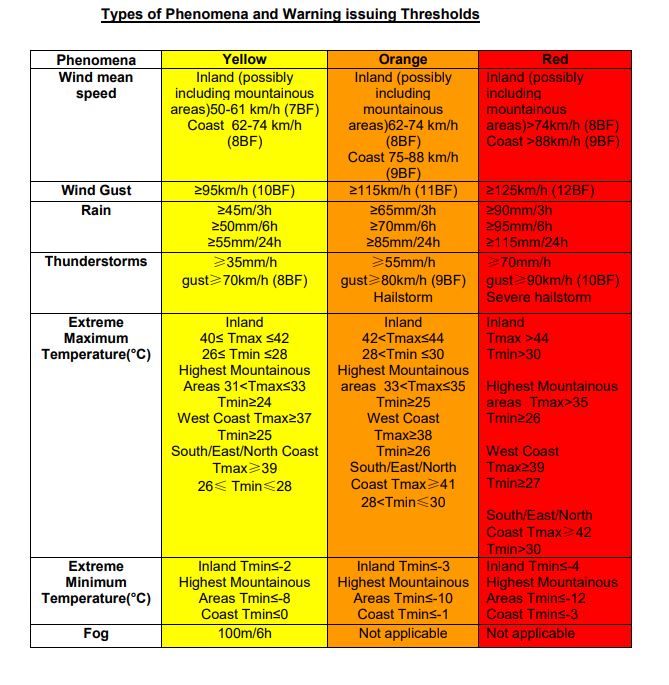
The Meteorological Department operates with formally established criteria for each warning colour. Dr Tymvios recalls that in 2004–2005 the department conducted research and defined thresholds based on Cypriot climatological data, by type of phenomenon and warning level.
For example, thresholds for extreme heat are higher than in northern Europe, as high temperatures are more common in Cyprus. In the near future, he says, a review of these criteria is under consideration, precisely because climate change is gradually altering the conditions on which the existing thresholds were based.
The philosophy behind the warning system is clear. Yellow denotes “potentially dangerous” conditions, orange indicates “dangerous” and unusual phenomena with possible damage, and red signifies “extremely dangerous” conditions.
Why the public gets confused
According to Dr Tymvios, confusion stems largely from an era of information overload. Traditional media and social media follow different approaches, leaving citizens in what he describes as a “grey zone of confusion” about what is actually happening.
While most reputable outlets draw information from the Meteorological Department, he warns of a particularly risky local phenomenon: untrained individuals on social media issuing unofficial warnings without any institutional framework, alongside clickbait headlines that exaggerate weather developments to attract attention.
In this environment, he adds, platforms such as Facebook are not meaningfully regulated, and accountability is largely absent.
Weather is not black and white
Eric Kitas, meteorologist and founder of the KitasWeather platform, agrees that misinterpretation is not only a matter of language but also of the nature of weather itself.
He emphasises that yellow warnings are probabilistic. In a detailed article on weather alerts, he explains that a yellow warning means conditions are potentially dangerous, the forecast phenomena are not unusual, and there is a possibility they may not occur at all or may be significantly milder.
In other words, yellow is not a signal of disaster but an advisory level of awareness, particularly for outdoor activities.
He notes that when warnings concern strong winds, conditions are often felt across an entire warning zone. However, when they involve isolated thunderstorms, it is entirely possible for heavy rain to affect one area while a few kilometres away conditions remain dry. This often leads citizens to perceive warnings as exaggerated or incorrect.
KitasWeather has divided the island into zones, distinguishing between mountainous and coastal areas, and applies slightly stricter criteria where topography and infrastructure increase risk. He also underlines that weather changes rapidly and forecasts inherently involve uncertainty, something “everyone needs to take into account”.
“Weather is not black and white,” he says.
Mobile alert system coming in 2026
Panagiotis Lambrianides, spokesperson for Civil Defence, told Politis that a contract has already been signed to introduce a mobile phone warning system for everyone within the Republic of Cyprus.
The system is expected to become operational in the first half of 2026. Alerts will be triggered depending on the type of threat, such as earthquakes, fires or severe weather, and will be location-based, ensuring messages reach people in affected areas immediately.
Notifications will be sent in both Greek and English, covering residents and visitors alike.