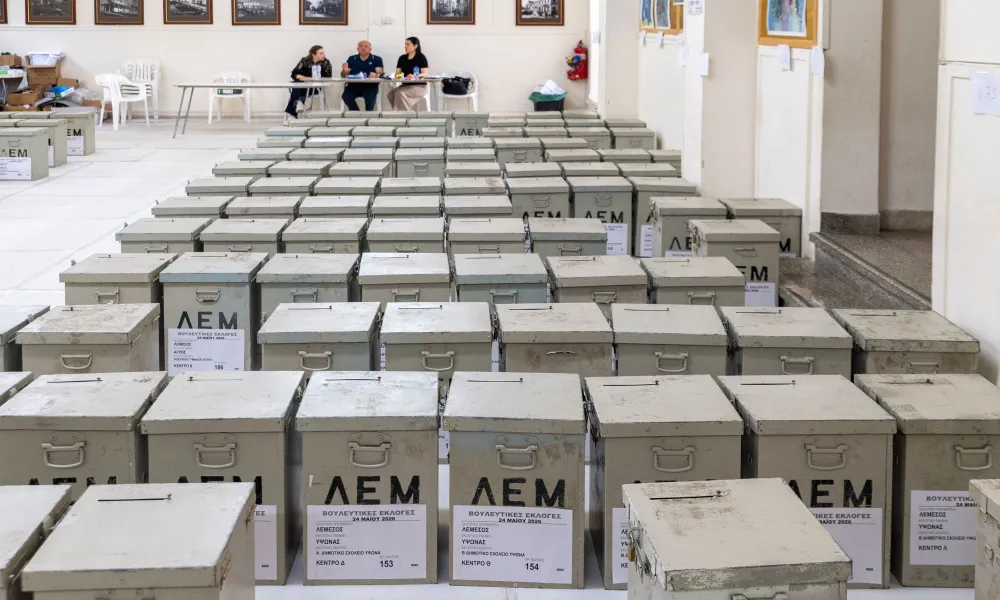
The composition of the House of Representatives that will emerge tonight takes on particular political significance. Not only in substance but, one could say to an equal extent, in terms of the messages expected to be sent to the entire political system. For the simple reason that historical experience shows that every new composition of the House consistently functions as a key indicator of political balances, social trends and party resilience.
The test
Of particular interest is the trajectory of the Democratic Rally (DISY) following the political developments that followed the 2023 presidential elections. Despite the fact that it remains a dominant political force, the party has in recent years faced internal turbulence that has affected its identity, both at the level of strategy and of day‑to‑day tactics.
Today’s electoral contest is expected to be assessed as an indication of whether DISY retains its political and electoral cohesion, or whether the voter shifts recorded in the presidential elections had more permanent characteristics. At the same time, its performance will inevitably influence the discussion on its ability to shape an autonomous strategy ahead of the 2028 presidential elections.
AKEL and the opposition
AKEL remains the main force of the opposition, seeking to articulate the dissatisfaction evident in parts of society towards government policy, banking monopolies and the broader state of the economy and citizens’ daily lives.
However, beyond its electoral performance – that is, whether it withstands the pressure it faces in successive contests – the key political question concerns whether it can generate broader governing momentum and convince that it constitutes a realistic alternative proposal for power. The picture so far suggests that, despite the overall erosion of the political system, the opposition continues to search for a stable majority social current.
Governance
The performance of the parties that supported the current President in the 2023 presidential elections also takes on particular significance.
The results of these parties are expected to be interpreted politically in relation to the overall image of the government and the social reach of the current presidency. At the same time, persistently high abstention in parliamentary elections makes any reading of the result more complex, since a decline in percentages does not always signify direct voter movement to other political forces, but often reflects broader disengagement from the political system.
Particularly for DIKO, the result will be seen as a significant indicator of the resilience of the centrist space and of its strategy of cooperation with the current government in the first instance, as well as whether it will seek to return to tactical alliance logic with DISY.
It is also of particular interest to determine whether, based on opinion polls, parties such as EDEK and DIPA will ‘evaporate’ or whether they will withstand the pressure and remain part of the new House of Representatives.
Consolidation of the far right
At the same time, particular importance is attached to the trajectory of ELAM, which appears to be gradually consolidating its presence as a significant political force.
Its strengthening is not merely an electoral phenomenon but is also linked to broader social and political trends observed in recent years, such as growing distrust towards the political system, concerns over migration, and the reinforcement of harder political approaches – driven in part by successive governments – particularly in relation to the Cyprus problem.
The presence of a strengthened ELAM affects the overall balance within the right‑wing space and is expected to be a significant factor in future political developments as well.
The new – and not only the new
Interest is also drawn to the presence of newer political formations – ALMA, Direct Democracy and Volt – which seek to express different social and political sensitivities outside the traditional party framework.
Regardless of their electoral performance, the presence of such formations reflects the desire of part of society for renewal of political discourse, alternative forms of political participation and the search for different approaches in relation to traditional parties. At the same time, this mobility confirms the gradual fragmentation of the political landscape and the difficulty of maintaining older party alignments.
The road to 2028
The outcome of today’s electoral contest, beyond the composition of the new House and the internal forces that will align in the election of its presidency, will also affect the way parties approach the 2028 presidential elections. In short, the result will constitute a reference point in relation to:
- The cohesion and strategic direction of the major parties
- The influence of the parties supporting the government
- The opposition’s ability to shape a credible alternative proposal for power based on the new party landscape
- The momentum of new political alignments
From this perspective, today’s contest is expected to directly influence political alliances, internal party discussions and the strategy of all political forces ahead of the 2028 presidential elections, without, however, allowing definitive or absolute political conclusions to be drawn solely from the outcome of a parliamentary ballot.