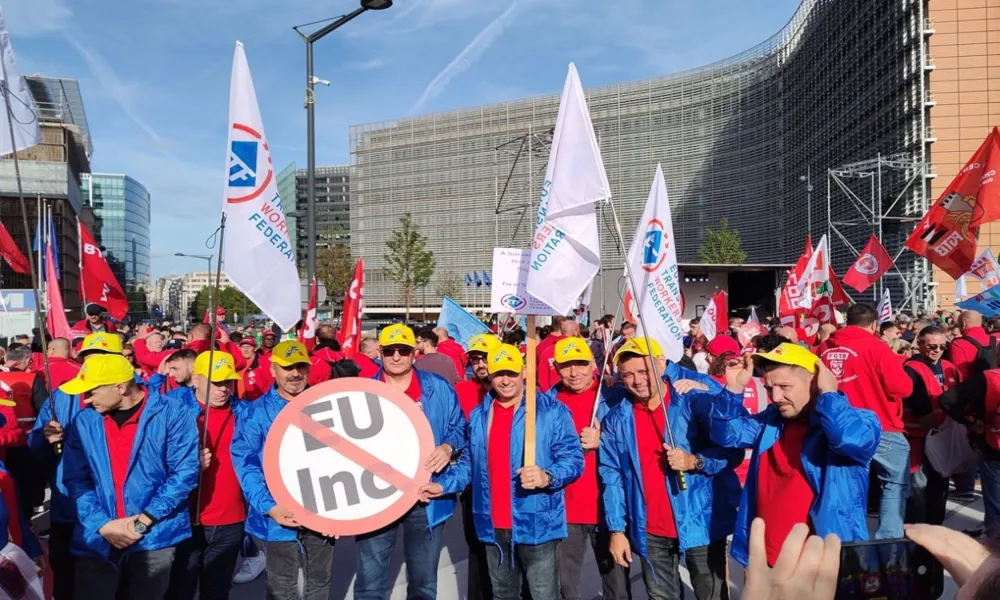

Trade unionists from across Europe took to the streets of Brussels on Thursday, warning that the proposed “EU Inc.” framework could undermine workers’ rights, collective bargaining and employment standards across the bloc.
The demonstration was organised by the European Trade Union Confederation (ETUC), together with Belgian unions ACV-CSC, FGTB-ABVV and SYNOVA, with participants demanding quality jobs, fair wages and strong collective agreements.
Under the slogan “Enough: Fix or Sink EU Inc. We Demand Quality Jobs”, protesters gathered in the Schuman area as the Council of the EU discussed the proposal.
Unions warn of ‘race to the bottom’
The proposed legislation, also known as the 28th Company Regime, is intended to create an additional EU-wide corporate framework.
Trade unions are calling on ministers to “fix or reject” the proposal, warning that its current form could trigger a race to the bottom in wages, working conditions and social standards.
A legal analysis by the European Trade Union Institute (ETUI) concluded that the proposal could allow companies to:
- Register in member states with lower social and labour standards, even when their employees work elsewhere.
- Offer stock options instead of wages or employment contracts.
- Circumvent workers’ rights to participate in decision-making and receive board-level representation.
- Avoid obligations to inform and consult employees before decisions affecting them.
- Accelerate company liquidation procedures in ways that could leave workers without payment of wages already earned.
ETUC calls for legally binding safeguards
ETUC urged ministers to introduce legal safeguards into the proposed legislation.
The European Commission has said it does not intend the framework to affect workers’ rights. However, according to the unions, the proposal does not contain legally binding guarantees capable of preventing employers from exploiting potential loopholes.
“The loopholes in the EU Inc. policy are so big they can be seen from space and will be easily exploited by unscrupulous employers unless appropriate legal safeguards are included,” ETUC General Secretary Esther Lynch said ahead of the demonstration.
Fears companies could seek lower labour costs
Lynch argued that the proposal in its current form could allow a company based and operating in Belgium to register in Bulgaria, which currently has the lowest minimum wage in the EU, and employ workers under lower wages and less favourable conditions.
“This is obviously absurd and could easily be fixed if, as the European Commission insists, the objective of this policy is not to trigger a race to the bottom in wages and labour standards across Europe,” she said.
Without sufficient safeguards, Lynch warned that statutory employment rights and collective agreements built up by workers over the past century could be put at risk.
Cypriot unions join Brussels protest
Cypriot trade unions also participated in the demonstration.
SEK General Secretary Andreas Matsas said efforts to strengthen European competitiveness could not come at the expense of workers’ dignity and rights.
He stressed the need to protect collective agreements, fair wages and quality employment.
“We will not compromise on fewer employment rights,” was SEK’s message from Brussels.
Matsas added that workers across Europe remain united and determined to defend their rights, as pressure mounts for stronger labour protections to be incorporated into the proposed EU framework.