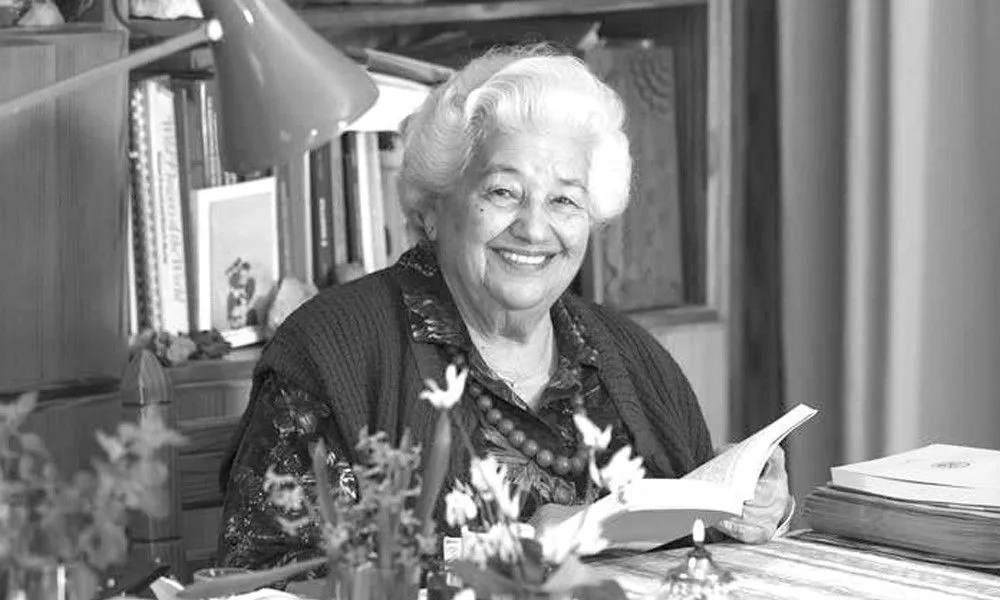
Writer Rina Katselli was the first Greek Cypriot woman to be elected to the House of Representatives. She was born in Kyrenia in 1938 and graduated from the city’s Greek Gymnasium. While still a student, she joined the 1955–59 struggle against British colonial rule and was imprisoned.
In 1959, she married Stelios Katsellis, later Minister of the Presidency and of Education, with whom she had four daughters and one son. Before the invasion, the Katsellis family owned the Doom Hotel in Kyrenia. She lived in her hometown until its occupation by Turkish forces in July 1974. She passed away on 28 May 2021 at the age of 83.
Rina Katselli developed multifaceted and wide‑ranging activity in political life, leaving a positive imprint and contributing to the more active involvement of many women in politics. She was a leading figure in cultural affairs and an active participant in the intellectual life of Cyprus.
She produced a rich body of literary work across all genres of literary expression – theatre, the novel and poetry – part of which was translated into English, French, Spanish and Russian. Through her writing, readers feel the warmth of her spirit overflowing, her deep concern for her wounded homeland and her unwavering commitment to the struggle for return to the occupied territories. Above all, they feel her boundless love for her city, her deeply beloved Kyrenia.
Reconnecting Kyrenians
After the Turkish invasion, her family took refuge in Limassol, where the displaced Municipality of Kyrenia found a welcoming home at Limassol’s Municipal Hall. Many Kyrenian refugees had also sought refuge in the city.
Stelios Katsellis’ sense of responsibility towards supporting displaced Kyrenians, combined with Rina Katselli’s social sensitivity towards supporting women, contributed to the establishment in Limassol, under the auspices of the Municipality of Kyrenia, of the Organisation of Cottage Industries for Displaced Women, which supported many families.
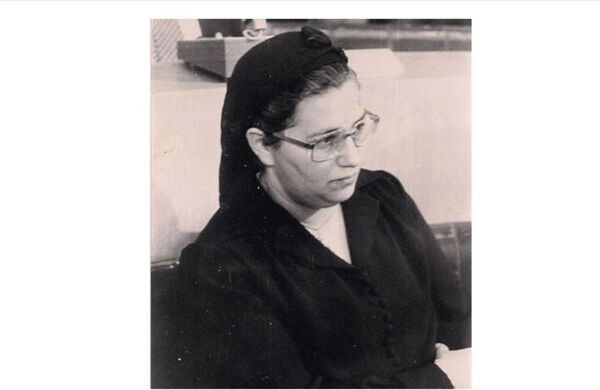
When the family settled in Nicosia in 1978, her concern was the reconnection of displaced Kyrenians and the reorganisation of the Kyrenia Folklore Association. As the association’s secretary for forty years, later as head of its publications and from 2015 as its honorary president, Rina Katselli was consistently the driving force behind it.
She always shouldered responsibility for organising all events, as well as for writing dozens of books on Kyrenia, published by the folklore association.
DIKO MP
Her social sensitivity towards defending women’s rights also defined her political activity. She organised the first women’s groups that formed the women’s organisation of the Democratic Party (GODYK).
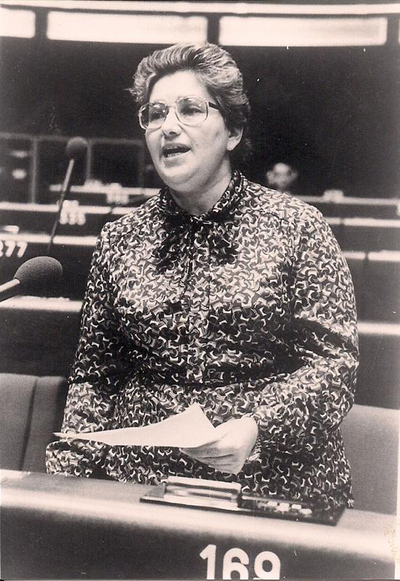
As a DIKO MP from 1981 to 1996, representing the Kyrenia district, the first Greek Cypriot woman in parliament supported women’s struggles for equality, while also advocating for the rights of refugees.
Award‑winning writer
Rina Katselli was honoured with the State Literary Award for her works The Mountains of Tramountana (1975), In Eptalofi, Blue Whale (1979) and Savvas Christis the Different: His Life and Work. In 2010, she received the Medal of Letters, Arts and Sciences.
She was also awarded first prize in the Pierides Competition for her novella The Hideout of Fountzios (1962).
Several of her plays were broadcast on radio, presented on television and staged theatrically. These include Introspection (Award of the Cyprus Playwrights’ Association, 1979), Whom the Robot Joined (CyBC Television Competition Award, 1969), Unworthy (Cultural and Intellectual Development Award, 1963), The Iron Ladle (CyBC Competition Award, 1960), Crazy Granny (THOC, 1986–87) and Why Valou Left (1986).
Rina Katselli also engaged in painting, particularly iconography. She learned the egg‑tempera technique from the icon‑painter nuns of the Monastery of Agios Minas (1974–75). Her works were exhibited in solo exhibitions in Limassol in 1975 and in Nicosia in 1978.
“A refugee in my own land”
Kyrenia was an inexhaustible source of inspiration for the writer. The city lives on through many of Rina Katselli’s books, as she sought to preserve and revive the past in order to restore the historical identity of her birthplace, so profoundly altered today by the Turkish occupiers.
In her book A Refugee in My Own Land, her powerful testimony of the trauma of the Turkish invasion and displacement as she experienced it in 1974, she writes:
“My homeland is Kyrenia, but Kyrenia is not only the geographical space now occupied by the invaders. I am a part of my city, my mother is part of it, and so are the forty centuries of Greek tradition that all Kyrenians carry within them.”