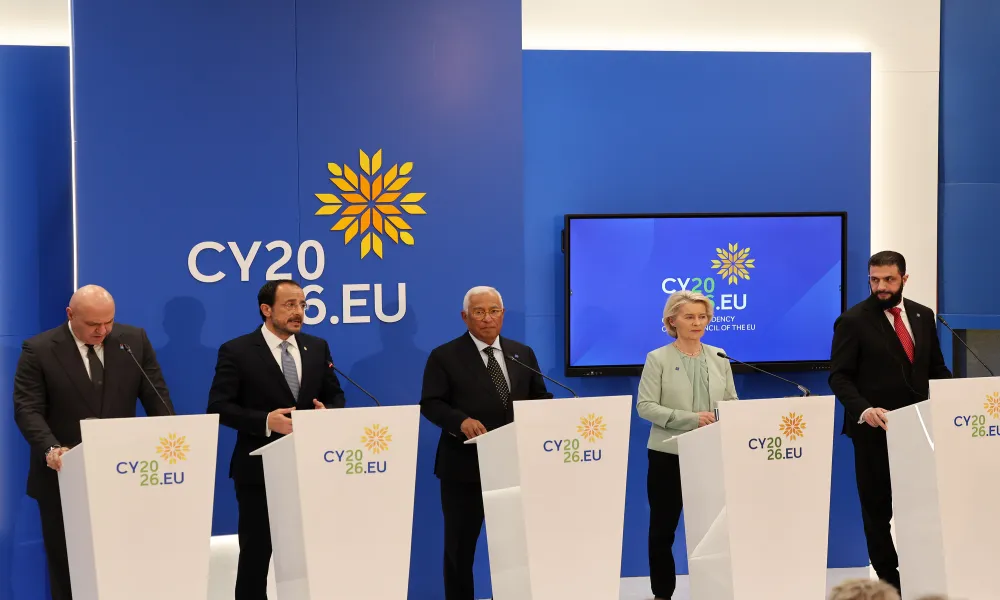


The presence of Middle Eastern leaders at the Informal European Council summit in Cyprus marked a turning point in how the EU is approaching its southern neighbourhood. Heads of state from Egypt, Lebanon, Syria and Jordan, along with the Secretary-General of the Gulf Cooperation Council, gathered in Nicosia as the bloc sought to coordinate at the highest political level in the wake of conditions created by the US-Israeli war against Iran. That interest, it appears, will not remain symbolic.
European Commission President Ursula von der Leyen announced that the EU will hold its "first high-level political dialogue" with Syria within two weeks, with the goal of concluding an association agreement with Damascus.
Each side used the summit to send its own messages. In that context, support was once again expressed for Cyprus, which, by virtue of its geography, has a natural role to play in the EU's neighbourhood policy toward the Middle East.
An additional point of interest is that the opening toward the Middle East is being linked to continued political support for Ukraine.
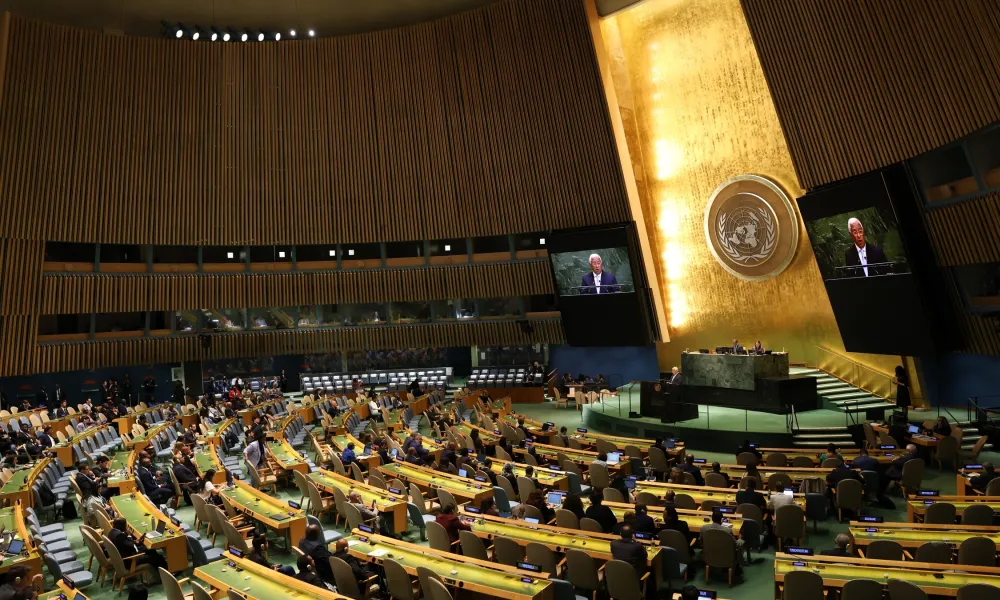
"Today, Europe faces a difficult security environment," said European Council President António Costa. "An environment that requires Europe to take a holistic approach to sustainable peace and security, and to act accordingly, whether in Ukraine or in the Middle East. Our meeting in Cyprus, in the current context, carries significant symbolic weight. It demonstrates the EU's firm and unequivocal support for the member states most affected by the ongoing conflict in the Middle East."
Von der Leyen struck a similarly forward-looking tone. "We are not just partners in crisis management, but partners for the future," she said.
Cyprus firmly aligned itself with that approach. "The security and stability of this region are inextricably linked to those of Europe. This is a vital neighbourhood, and it is the EU's neighbourhood," President Nikos Christodoulidis said after the conclusion of the summit's proceedings.
Foreign Minister Constantinos Kombos went further in an interview with Politico, arguing that European countries must strengthen their strategic presence in the Middle East, forge agreements with partners across the region, and work to bring the war with Iran to an end.
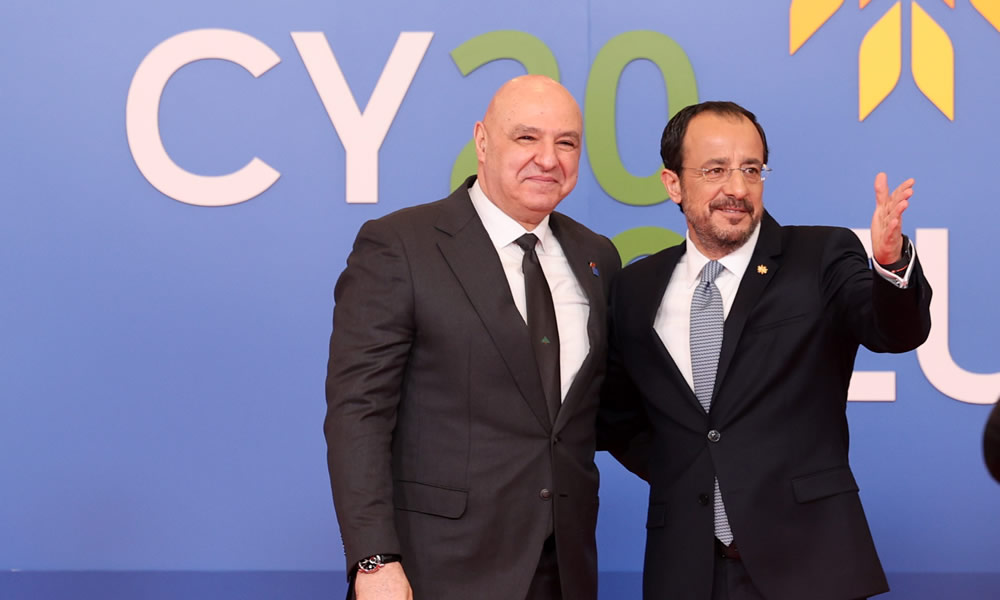
Lebanese President Joseph Aoun described the humanitarian toll his country is bearing, telling the summit that Lebanon is "paying a very heavy humanitarian price." He nonetheless expressed optimism about the country's potential, pointing to vast opportunities for economic integration and connectivity in services and trade.
Syrian President Ahmed al-Sharaa called the Nicosia meeting a demonstration of political maturity, and argued that European and Middle Eastern security are inseparable. "Europe needs Syria as much as Syria needs Europe," he said, while also calling on the international community to take responsibility for what he described as Israeli aggression on Syrian territory.
Cyprus and Egypt sign strategic partnership declaration
On the sidelines of the summit, Cyprus and Egypt signed a Joint Declaration establishing a strategic partnership. Government sources described the relationship as entering a more mature, institutionally grounded and strategically organised phase, calling it a significant political milestone. The declaration, they said, consolidates and further upgrades already excellent bilateral relations, making them more structured, more targeted and more effective. It is a development that demonstrates Cyprus's active and substantive role in shaping regional developments through trusted relationships, institutional seriousness and tangible results.
Article 42.7: A tabletop exercise for now
On the question of the EU's mutual defence clause under Article 42.7 of the EU Treaty, Politis understands that efforts will be made to draft a procedural manual for what happens when a member state requests its activation. A simulation exercise is scheduled for 4 May as a step in that direction. The prospect of a fully operational mechanism, however, appears some way off.
Von der Leyen acknowledged the clause requires further development to function effectively in practice. "The Treaty is very clear about what needs to be done," she said, noting that member states are obliged to assist one another. "The Treaty is not clear about what happens, when, and who takes on what."
Greek Prime Minister Kyriakos Mitsotakis expressed support for giving the mutual defence clause real substance. "I consider it very important that this issue has firmly entered the European Council's agenda," he said, adding that Greece will use its EU Council presidency in the second half of 2027 to advance the discussion further.