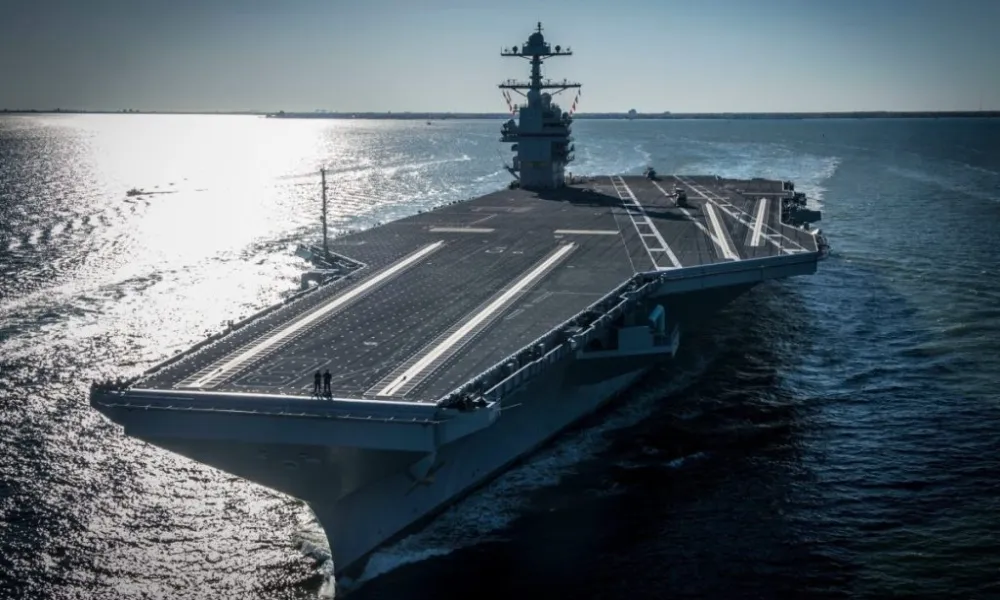

The world’s largest aircraft carrier, the USS Gerald R. Ford, has entered Mediterranean waters, according to maritime tracking data, marking a key phase in Washington’s repositioning of forces toward the Middle East amid rising tensions with Iran.
The deployment follows orders issued last week by US President Donald Trump, as the White House examines the possibility of military action against Tehran.
Tracking platforms recorded the Arleigh Burke-class destroyer USS Mahan, part of the Ford carrier strike group, transiting the Strait of Gibraltar, confirming the operation’s progression.
Military analysts estimate that several more days will be required before the strike group reaches full operational readiness in the broader Middle East region.
What happens if Washington orders a strike
The US military buildup has drawn comparisons with deployments preceding the 2003 invasion of Iraq. While some analysts argue the mobilisation may serve as negotiation pressure, with Trump reportedly giving Tehran 10 to 15 days to reach an agreement, contingency planning appears advanced.
According to assessments cited by the BBC, seven main scenarios could unfold if the United States authorises military action.
Limited precision strikes and political transition
Targeted attacks against facilities of Iran’s Islamic Revolutionary Guard Corps and against missile and nuclear infrastructure could weaken the ruling establishment. However, experience from Iraq and Libya suggests that military intervention rarely produces smooth democratic stabilisation and often leads to prolonged instability.
Regime survival with tactical concessions
Iran’s leadership might survive but be forced to curb its nuclear and missile programmes and limit support to allied armed groups in the region. Supreme Leader Ali Khamenei has shown little inclination toward major compromise, making this outcome uncertain.
Hardline military consolidation
A weakened civilian structure could be replaced by a more openly military-dominated system centred on the Revolutionary Guards, particularly if instability follows external strikes.
Iranian retaliation against US and regional allies
Tehran has warned it would respond directly to any attack. Potential targets include US bases in the Gulf and regional allies such as Israel and Jordan. The 2019 attacks on Saudi Aramco facilities demonstrated the vulnerability of energy infrastructure in the region.
Disruption of the Strait of Hormuz
Around 20 percent of global liquefied natural gas and up to a quarter of global oil shipments transit the Strait of Hormuz. Mining or blocking the passage would have immediate consequences for global trade and energy prices, affecting major importers including China.
Direct attack on a US naval vessel
A further escalation scenario involves a successful asymmetric attack using drones or fast vessels against a US warship. Historical precedent includes the 2000 attack on the USS Cole in Yemen, underscoring the potential impact of such operations.
State collapse and regional fragmentation
A full-scale destabilisation of Iran, home to approximately 93 million people, could trigger internal fragmentation and civil conflict. Such an outcome would have far-reaching humanitarian and geopolitical consequences across the Middle East.
Potential US and Israeli targets
Israeli outlet Ynet reports that in the event of coordinated action, initial objectives would include neutralising Iranian air defences to secure air superiority. Subsequent targets would include ballistic missile stockpiles and drone capabilities, with Israel prioritising long-range systems threatening its territory and the US focusing on assets capable of striking American bases in the Gulf.
Naval elements of the Revolutionary Guards would likely be targeted to prevent disruption of shipping lanes. Underground missile storage and launch facilities would also be high-priority objectives. Analysts note that US capabilities may be particularly relevant for deeply buried nuclear facilities such as those near Natanz and Fordow.
A conflict without a defined end
Analysts warn that the principal risk lies not in the opening phase of a limited strike but in escalation without a clearly defined strategic objective. The concentration of US forces around Iran signals heightened readiness. Whether it serves primarily as deterrence, negotiation leverage or preparation for direct confrontation remains uncertain.